
Custom Software Development vs. Off-the-Shelf Tools: Which Saves Your Small Business More Time in 2026?
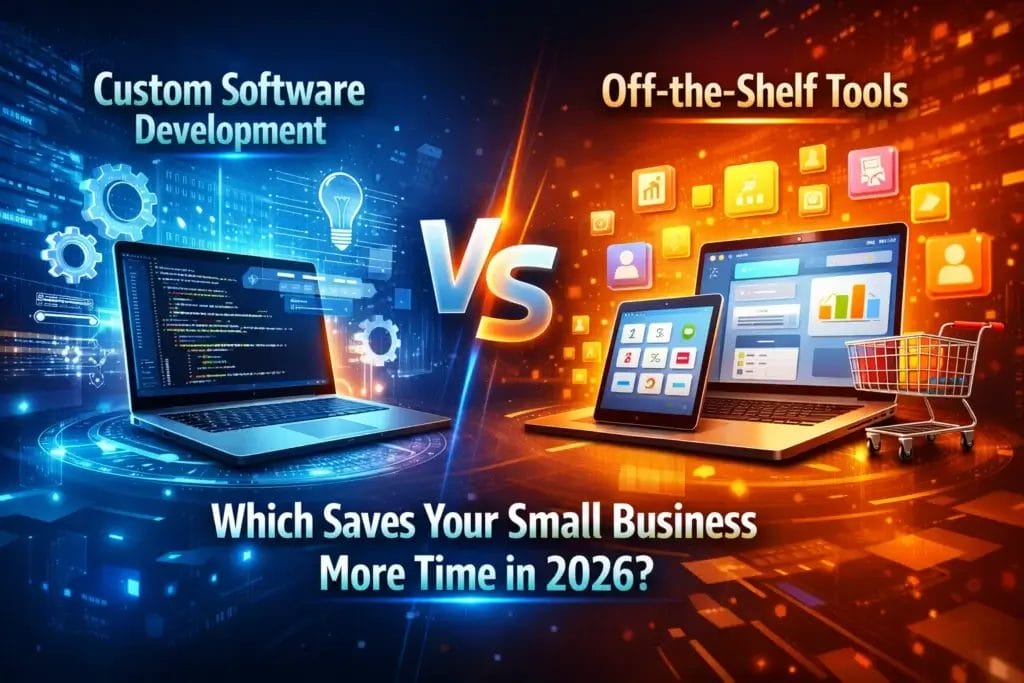
Time is the one resource your small business can't manufacture. You can raise capital, hire contractors, or scale your team, but you can't create more hours in the day. So when you're choosing between custom software development and off-the-shelf tools, the real question isn't about features or pricing. It's about time.
Which approach actually saves you more of it in 2026?
The answer depends on your timeline, and it's not what most business owners expect.
The Time Paradox: Fast to Start vs. Fast to Execute
Off-the-shelf tools win on day one. No question.
You can sign up for project management software, CRM platforms, or accounting tools and be operational within hours. Custom software development requires planning, building, testing, typically three to nine months for a complete solution.
But here's where conventional wisdom falls apart: the fastest solution to implement isn't always the fastest solution to use.
Think about it. You spend 30 seconds signing up for a tool. Then you spend the next two years forcing your team to adapt their workflows to fit what that tool can do. Every day, your employees waste minutes (or hours) navigating features you don't need, manually transferring data between systems that don't talk to each other, and working around limitations that slow them down.
Those minutes add up. Fast.

Off-the-Shelf Tools: The Reality Behind "Plug and Play"
Off-the-shelf software promises simplicity. And for standardized business processes, bookkeeping, basic CRM, email marketing, it delivers. These are solved problems with established best practices. Why reinvent the wheel?
But most small businesses don't operate in perfectly standardized ways. You have unique workflows, specific client requirements, and processes that evolved organically as you grew. Off-the-shelf tools force you into their mold.
The hidden time costs show up as:
- Employees learning workarounds for features that "almost" fit your needs
- Manual data entry between systems that don't integrate properly
- Time spent managing multiple subscriptions instead of one unified system
- Training new hires on convoluted processes that exist only because your tools require them
This is where workflow automation and business process automation become critical. When you automate business processes with tools like n8n automation or Airtable automation, you can bridge some gaps between off-the-shelf solutions. But you're still building on top of limitations.
Custom Software: The Long Game That Pays Daily Dividends
Custom software development flips the equation.
Yes, you invest three to nine months upfront (or just weeks with low-code approaches and automation consulting). But once deployed, your software works exactly how your business works. Not the other way around.
Your team doesn't adapt to the software. The software adapts to your team.
Time savings compound:
- Employees execute tasks in the exact sequence they need, with no extra steps
- Systems integrate seamlessly because they're designed together from day one
- New workflows get added without workarounds or third-party connectors
- Automation happens at every logical point, not just where generic tools allow it
This is especially powerful when you leverage AI automation for small business. Custom solutions can embed AI exactly where you need it: in your unique processes: rather than using generic AI features that don't quite fit.
The Integration Time Sink Nobody Talks About
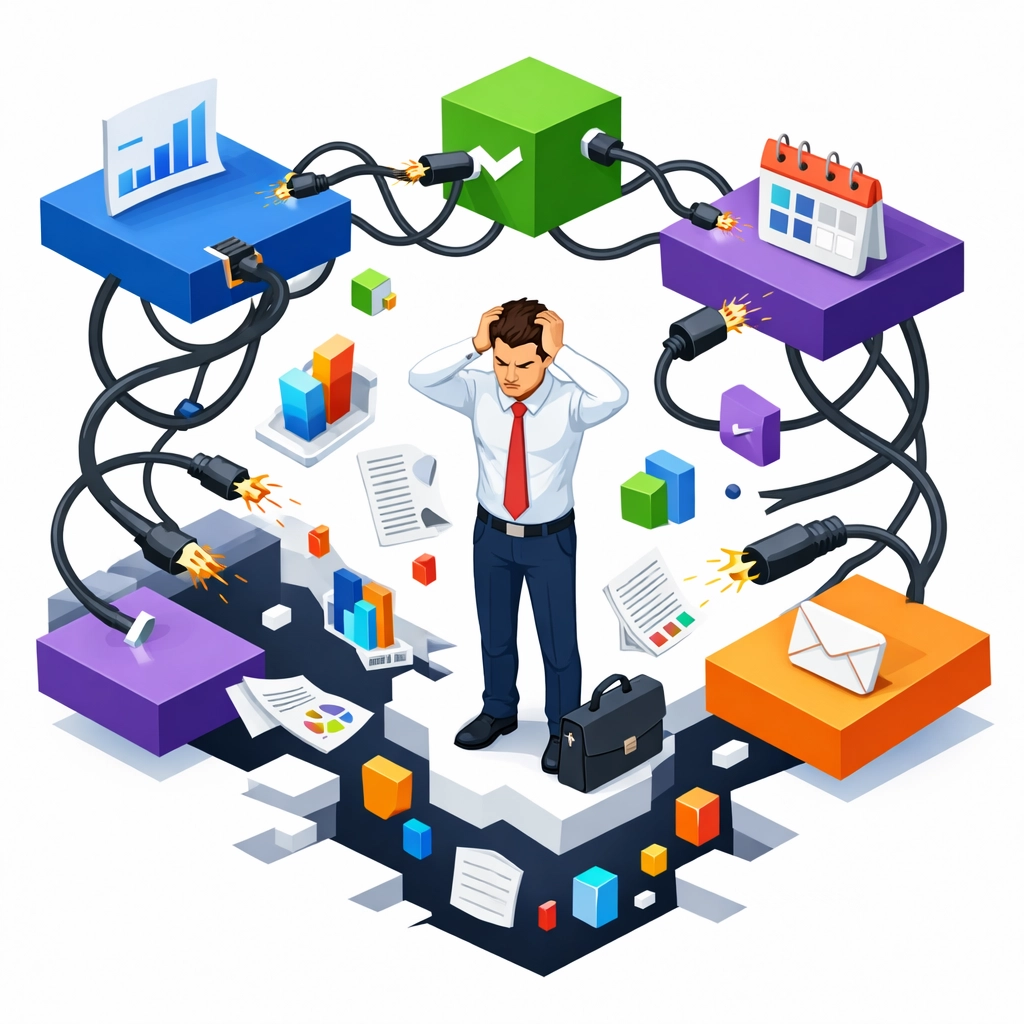
Here's the time killer that off-the-shelf vendors don't advertise: integration hell.
You adopt five different tools: one for CRM, one for project management, one for invoicing, one for marketing automation, one for customer support. Each one works great in isolation. But your business isn't isolated operations. It's connected workflows.
Now you need:
- Zapier subscriptions to connect everything
- Manual exports and imports for data that can't sync
- Regular checks to ensure connections haven't broken
- Time reconciling data discrepancies between systems
AI integration services can help unify your tech stack, but you're still layering solutions on top of tools that were never designed to work together. Custom software eliminates this entirely by building integration into the foundation.
When Off-the-Shelf Actually Saves Time
Let's be clear: off-the-shelf tools aren't the enemy. They're the right choice when:
You're running standard operations. Accounting, basic CRM, email marketing for straightforward campaigns: these have established patterns. Tools like QuickBooks, HubSpot, or Mailchimp solve these problems efficiently.
You need to validate quickly. Testing a new market or business model? Off-the-shelf gets you moving fast. Validate first, optimize later.
Your workflows are simple and stable. If your processes don't change often and they fit neatly into existing tool categories, why build custom?
You lack technical resources. Off-the-shelf tools come with support, updates, and maintenance handled by the vendor. For small teams without technical expertise, that's valuable.
When Custom Development Is the Time-Saving Hero
Custom software development becomes the efficiency multiplier when:
Your workflows are unique. If you're constantly saying "I wish this tool could do X," you're losing time daily. Custom software does X.
You're managing complex integrations. When your business depends on multiple systems talking to each other perfectly, custom development builds those connections reliably from the start.
You're scaling operations. Off-the-shelf tools handle small-scale use cases well. But as you grow, their limitations create bottlenecks. Custom solutions scale with you.
Your competitive advantage is operational efficiency. If speed and precision in execution differentiate you from competitors, custom software that eliminates every unnecessary step becomes a strategic asset.
You need specific automation. Generic marketing automation AI or workflow tools can't automate your exact process. Custom development with intelligent business process automation can.
The 2026 Reality: Hybrid Is the Smart Play
Here's what forward-thinking small businesses do in 2026: they don't choose one or the other exclusively.
They use off-the-shelf tools for commoditized functions. Accounting. Email. Basic storage.
They invest in custom software development for their core workflows: the processes that define how they deliver value to customers. The operations that, when optimized, multiply their output without adding headcount.
And they connect everything with intelligent automation: using n8n automation, Airtable automation, or custom-built workflows that make disparate systems work as one.
This hybrid approach gives you speed where you need it and precision where it matters most.
Your Time-Saving Decision Framework
Ask yourself these questions:
1. How much time do employees currently waste working around tool limitations?
If the answer is "more than an hour per week per person," you're losing serious productivity. Calculate that across your team over a year. The cost likely exceeds custom development.
2. How often do you manually transfer data between systems?
Every manual transfer is time lost and an error waiting to happen. If this happens daily, AI integration services or custom development pays for itself quickly.
3. Are you adapting your business to fit your tools, or vice versa?
If you've changed how you operate because your software couldn't accommodate your preferred workflow, that's a red flag. Your tools should serve your business, not dictate it.
4. What's your growth trajectory?
If you're planning to double in size within 18 months, off-the-shelf tools that work today might not scale tomorrow. Custom solutions built with growth in mind save you from painful migrations later.
5. Is your competitive edge operational?
If customers choose you because you're faster, more accurate, or more efficient than competitors, custom software that optimizes your operations is a strategic investment, not an expense.
The Verdict: It Depends on Your Timeline
Off-the-shelf tools save time this week. Custom software saves time every week for years.
For small businesses in 2026, the smartest approach isn't about choosing sides: it's about strategic allocation. Use off-the-shelf where standardization makes sense. Build custom where your unique processes create value.
And above all, don't mistake speed of implementation for speed of execution.
The tool you can deploy fastest isn't always the tool that helps your team work fastest.
Ready to identify where custom development would multiply your team's efficiency? Talk to our automation consulting team about mapping your workflows and calculating real time savings. We specialize in custom software development and AI automation for small business: helping you automate business processes that actually matter.
Because in 2026, the question isn't whether to automate. It's whether to automate strategically.
