
Airtable Automation vs Custom Software: Which Is Better For Your Growing SMB?
You're scaling. Revenue is climbing. Your team is growing. And suddenly, the spreadsheets and manual processes that got you here are killing your momentum.
You need to automate business processes: fast. The question is: do you bolt on an Airtable automation solution, or do you invest in custom software development?
The answer isn't one-size-fits-all. But it's also not complicated.
What Airtable Automation Does Well
Airtable is a workflow automation powerhouse for the right use cases. It's visual, intuitive, and doesn't require a development team to get started. For growing SMBs, that speed-to-value matters.
Here's where Airtable shines:
- Quick implementation – You can build automated workflows in days, not months
- No-code interface – Your operations team can own it without technical dependencies
- Built-in integrations – Connect to hundreds of apps through native connections and Zapier
- Conditional logic – Trigger actions based on field values, status changes, or scheduled events
- Database flexibility – Organize complex relational data without traditional database constraints
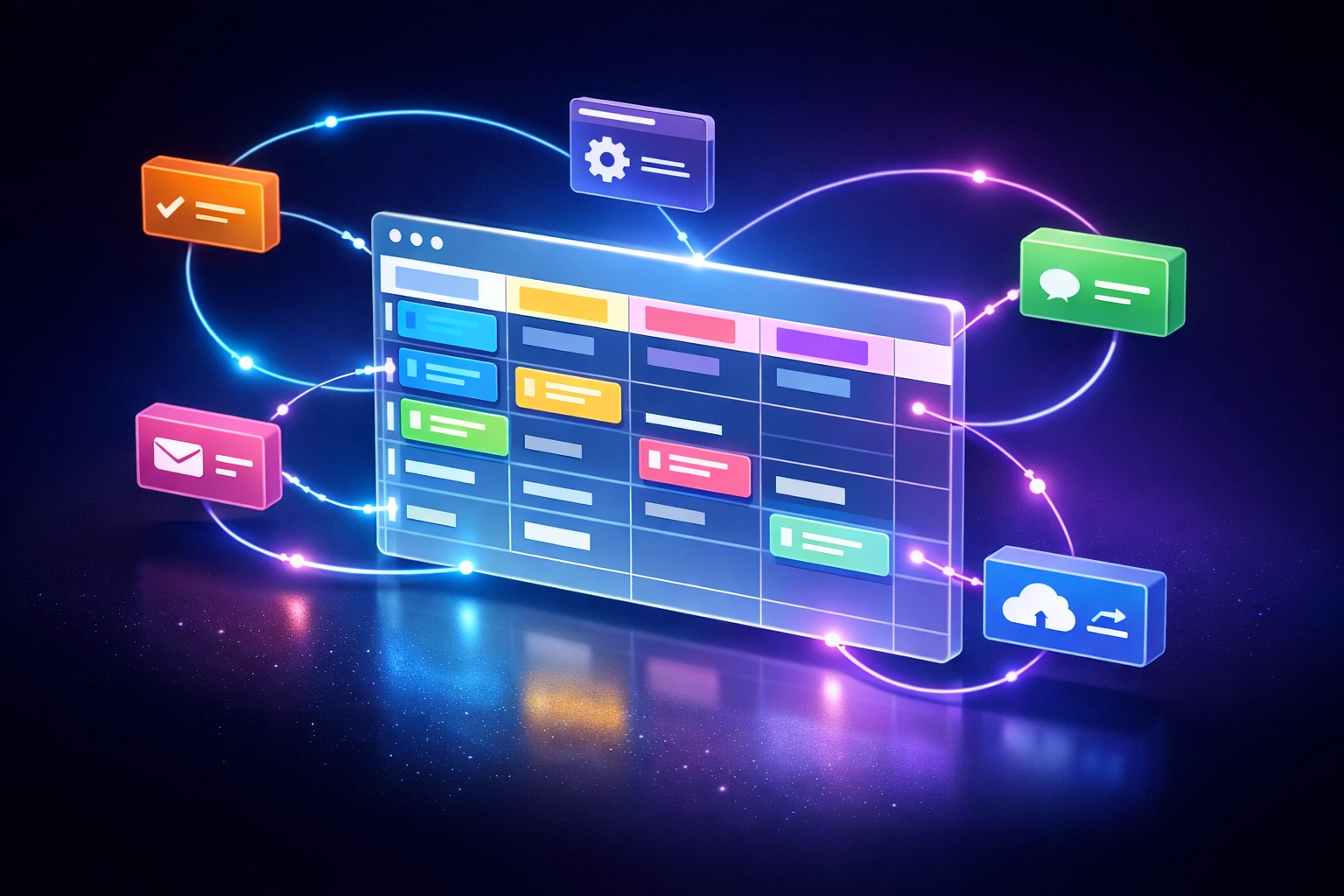
For straightforward business process automation like lead tracking, project management, or content calendars, Airtable delivers. Fast.
But speed comes with trade-offs.
Where Airtable Automation Falls Short
Airtable has a ceiling. And when your SMB hits it, you'll know immediately.
The platform's limitations become painful as complexity grows:
No white-labeling or custom branding. If you're building client-facing tools or want automation that represents your brand, Airtable won't cut it. Your customers see Airtable's interface, not yours.
Per-user pricing scales poorly. As your team expands, costs multiply. What starts as $20/month per user becomes $20,000/year across a 50-person team: and that's before you factor in premium features.
Mobile functionality is limited. Apps built with Airtable's Cobuilder don't work properly on mobile devices, restricting field operations and remote teams.
Advanced logic requires workarounds. While Airtable supports JavaScript, it's not designed for complex AI integration services or sophisticated automation sequences. You'll find yourself fighting the platform rather than leveraging it.
Data security and compliance constraints. For industries with strict regulatory requirements, Airtable's shared infrastructure model creates risk you can't fully mitigate.
The reality? Airtable automates workflows. It doesn't transform operations.
The Custom Software Alternative
Custom software development solves a different problem entirely.
When you build custom, you're not just automating tasks: you're creating autonomous systems that operate exactly how your business needs them to.
Complete control over logic and functionality. No platform limitations. No feature requests waiting in someone else's backlog. Your automation does exactly what you designed it to do.
Unlimited scalability. Custom solutions grow with you. Whether you're processing 100 transactions or 100,000, the system adapts without per-user fees strangling your margins.
True AI automation for small business. Integrate GPT-4, Claude, or custom ML models directly into your workflows. Build intelligent agents that make decisions, not just execute predefined rules.
White-label everything. Client portals, customer dashboards, automated reporting: all branded as yours. Your automation becomes a competitive advantage, not a commodity tool.
Security and compliance by design. Build exactly the data protection, audit trails, and access controls your industry requires.
But custom development has a reputation problem: it's expensive and slow.
That used to be true. Not anymore.
The Hybrid Approach: n8n + Custom Integration
Here's what most automation consultants won't tell you: you don't have to choose.
At Yotomations, we've built hundreds of automation solutions that combine the best of both worlds: n8n automation platforms with custom software components.
n8n is open-source workflow automation without the pricing traps. It's more powerful than Airtable, more flexible than Zapier, and completely self-hosted. You own it.
The approach looks like this:
- Core workflows run in n8n – Trigger-based automation, API connections, data transformations
- Custom components handle complexity – AI agents, advanced logic, proprietary algorithms
- Purpose-built interfaces serve specific needs – Client dashboards, mobile apps, branded portals
- Everything integrates seamlessly – One system, multiple tools, zero manual handoffs

This hybrid model delivers enterprise-grade marketing automation AI at SMB budgets. You get speed where you need it and precision where it matters.
Decision Framework: Which Path Is Right For You?
Stop overthinking this. Ask three questions:
1. Is this automation customer-facing or internal-only?
If customers interact with it, custom software wins. If it's purely operational, Airtable or n8n might be enough.
2. Will you need this automation in 3 years?
Short-term projects favor quick-build tools. Long-term systems justify custom investment. Calculate the 3-year total cost of ownership: Airtable's per-user fees often exceed custom development costs over time.
3. Does your competitive advantage depend on this process?
If automation is table-stakes (like email sequences), use off-the-shelf tools. If it's core to your value proposition, build custom. Your differentiation can't live in someone else's platform.
Here's the reality check most businesses need: start with Airtable or n8n, then graduate to custom when you hit the ceiling.
There's zero shame in beginning with no-code tools. They're perfect for validating workflows and proving ROI before investing in custom builds.
But don't confuse convenience with strategy. Airtable automation is a stepping stone, not a destination.
What Smart SMBs Are Building Right Now
The businesses winning with automation in 2026 aren't choosing between Airtable and custom software. They're strategically deploying both.
Operations tier: n8n handles routine workflow automation: lead routing, data sync, scheduled reports
Intelligence tier: Custom AI agents analyze data, make decisions, and trigger complex sequences
Experience tier: Branded custom interfaces deliver seamless customer and employee experiences
This three-tier approach means you're not locked into any single platform's limitations or pricing model. You automate business processes at the appropriate level of sophistication for each use case.

The companies building this way? They're moving faster than competitors stuck in all-custom builds. And they're more scalable than teams duct-taping Airtable to breaking point.
Building Your Automation Strategy
Here's your action plan:
Map your processes by complexity and visibility. Not everything needs custom development. Not everything can survive in Airtable.
Calculate true costs over 36 months. Include per-user fees, integration costs, and the hidden tax of platform limitations forcing workarounds.
Start with quick wins using n8n or Airtable. Prove the ROI of automation before writing custom code.
Identify your automation bottleneck. Where is manual work costing you the most money or killing the most momentum? That's your first custom build.
Work with experts who understand both worlds. The best automation consulting doesn't push a single solution: it architects the right mix for your specific situation.
The Bottom Line
Airtable automation is fast, accessible, and perfect for straightforward workflows. Custom software development delivers unlimited capability, scalability, and competitive differentiation.
Neither is "better": they solve different problems.
Growing SMBs win by knowing exactly when to use each approach. Start with no-code tools to validate and iterate. Graduate to custom builds when automation becomes your competitive edge.
The businesses that figure this out? They're not drowning in manual work while competitors scale past them. They're building autonomous operations that multiply output without multiplying headcount.
That's the real advantage of smart automation strategy. Execution.

[…] you need to make executive decisions without opening ten different apps. Check out our guide on Airtable automation vs. custom software to see which fits your […]
[…] Spreadsheets are where data goes to die. Use airtable automation to create a single source of truth for your operations. Whether it’s inventory, project tracking, or CRM, Airtable can trigger actions across your tech stack the moment a status changes.Learn more about Airtable automation vs. custom software. […]
[…] many businesses, Airtable automation vs custom software is the critical […]
[…] without needing a full-scale database. It’s visual, flexible, and powerful. We often recommend Airtable automation vs. custom software comparisons to help owners decide which path fits their growth […]
[…] track every single task you perform. Don't worry about being fancy; a simple Notepad or a basic Airtable grid will do. You’re looking for three specific types of […]