
Workflow Automation vs. Custom Software Development: Which Investment Pays Off Faster for SMBs?

You're stuck between two paths. Build custom software from scratch, or automate business processes with existing tools? For most small and mid-sized businesses, this decision directly impacts cash flow, team productivity, and competitive positioning for the next 18-24 months.
The wrong choice burns capital. The right one multiplies operational capacity without multiplying headcount.
Here's the reality: 92% of early automation adopters hit positive ROI, averaging $1.41 returned for every dollar spent. Custom software development? That's a different game entirely, one with longer timelines, higher risk, and significantly delayed payback periods.
Let's break down which investment pays off faster and when each approach actually makes sense for your business.
The Core Difference: Building vs. Connecting
Workflow automation connects your existing software tools, CRM, email platforms, spreadsheets, payment processors, into intelligent, automated sequences. Think of it as creating a nervous system between applications that already work.
Custom software development means building something from the ground up. New database architecture. Custom user interfaces. Proprietary business logic coded specifically for your operation.
The distinction matters because it determines three critical factors: initial investment, time to value, and ongoing maintenance costs.

Cost Comparison: The Upfront Investment
Workflow automation software ranges from $10-50 per user monthly for platforms like n8n automation or Airtable automation. Even with implementation costs factored in, most SMBs spend between $2,000-$15,000 to automate their first 3-5 critical business processes.
Custom software development? Budget $50,000-$250,000 minimum for a functional MVP. That's before iterations, user testing, or the inevitable scope adjustments that occur once stakeholders see the first version.
The math is stark. For the cost of one custom software build, you could implement comprehensive workflow automation across sales, marketing, operations, and customer service, with budget left over for AI integration services.
Time to Value: When Do You See Results?
Here's where automation consulting delivers its most compelling advantage.
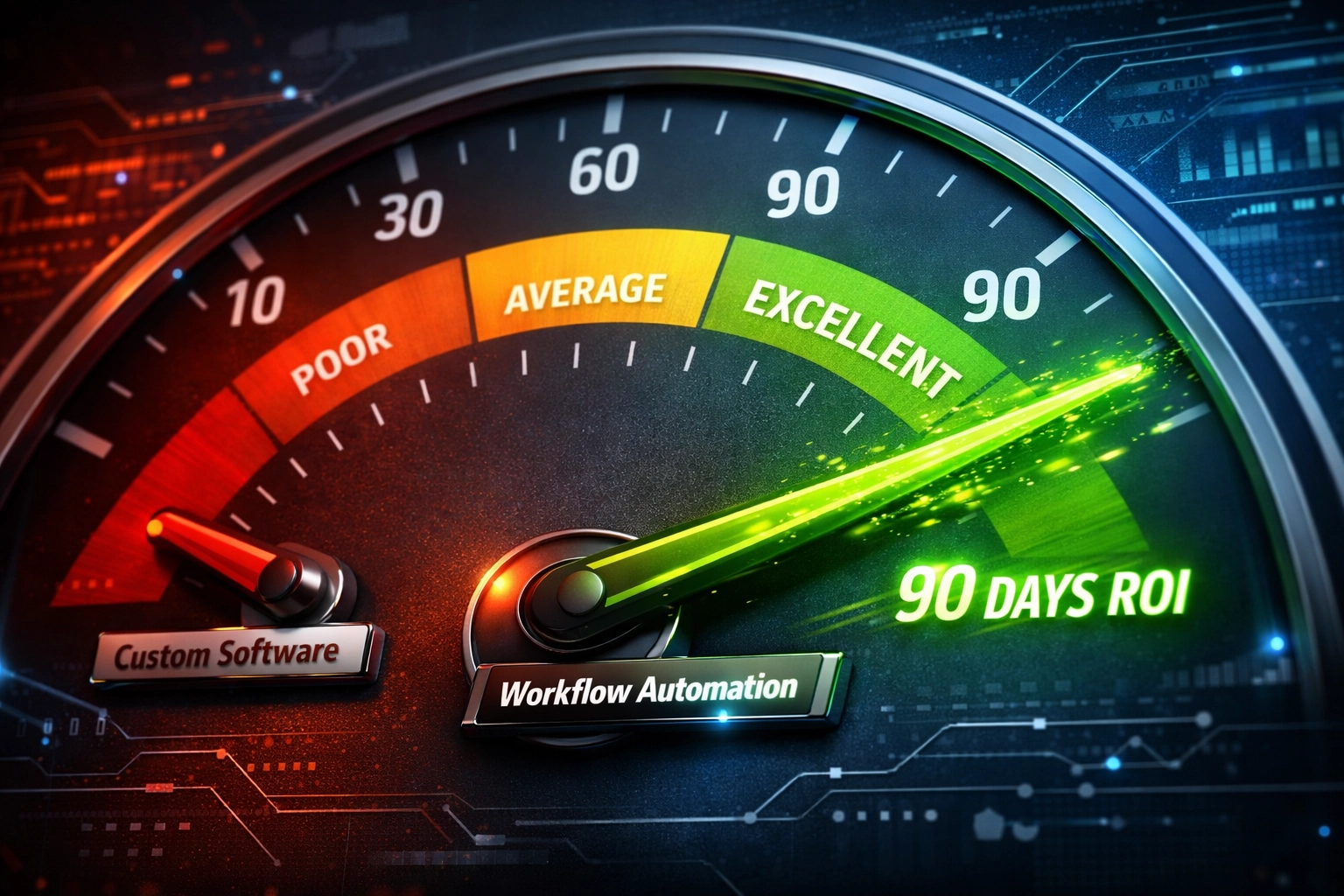
Workflow automation ROI appears within 90 days when implemented correctly. Many businesses see measurable time savings within the first 30 days. IBM reported a payback period of less than 6 months with a 3:1 ROI multiple on their automation initiatives.
The numbers don't lie:
- Small businesses save 12-20 hours monthly with basic automation
- Comprehensive implementation yields 40-60 hours monthly in recovered time
- Error reduction of 40-75% compared to manual processes
- Operational cost reductions averaging 35% in manual labor expenses
Custom software development timelines? Plan on 6-18 months from discovery to deployment. That's a year or more before you see any return. Your team continues manual processes. Competitors who chose automation have already scaled past you.

When Workflow Automation Wins (Most of the Time)
For ai automation for small business, workflow automation dominates when you're dealing with:
Repetitive administrative tasks. Data entry, form processing, lead routing, follow-up sequences, these kill productivity daily. Automation eliminates them completely.
Multi-system coordination. Your CRM doesn't talk to your project management tool. Your invoicing system operates in isolation. Marketing automation AI can bridge these gaps in days, not months.
Scalability without headcount. Revenue growing 40% shouldn't require hiring 40% more people. Automation creates the leverage point that makes growth profitable instead of just busy.
Quick market validation. Testing a new service offering? Automate the fulfillment process first. Validate demand before committing to custom software that might solve a problem customers don't actually have.
The beauty of business process automation? You can iterate fast. A workflow that's not quite right gets adjusted in hours. Custom software requires sprints, development cycles, and testing phases.
When Custom Software Actually Makes Sense
Custom development has its place. Not everything fits in an automation framework.
True competitive differentiation. If your IP lives in a proprietary algorithm or unique user experience that competitors can't replicate, custom software protects that advantage.
Industry-specific compliance. Heavily regulated industries sometimes require software architectures that off-the-shelf solutions can't accommodate. Healthcare. Financial services. Legal tech. These scenarios justify custom builds.
Complex user interfaces at scale. Building a customer-facing application serving thousands of concurrent users? That's custom software territory. Internal workflow automation won't cut it.
Unique data structures. If your business model requires database relationships that standard software can't handle, custom development becomes necessary.
Notice the pattern? Custom software makes sense when you're building external products or solving problems so unique that no existing solution applies.
For internal operations? Automation wins almost every time.
The Hidden Costs Nobody Talks About
Custom software carries ongoing expenses that destroy ROI projections:
Maintenance and updates. Plan on 15-20% of initial development costs annually just to keep the lights on. Security patches. Bug fixes. Operating system compatibility updates.
Technical debt. That custom codebase needs documentation, developer onboarding, and institutional knowledge transfer. Lose your lead developer? You're rebuilding relationships and context from scratch.
Feature creep. Custom software invites endless "wouldn't it be cool if…" conversations. Each feature adds complexity, costs, and potential failure points.
Workflow automation platforms handle maintenance automatically. Updates roll out without your involvement. Security gets managed by the platform provider. Your team focuses on business outcomes, not software babysitting.
The Hybrid Approach That Actually Works
Smart SMBs don't choose between automation and custom software. They sequence investments strategically.
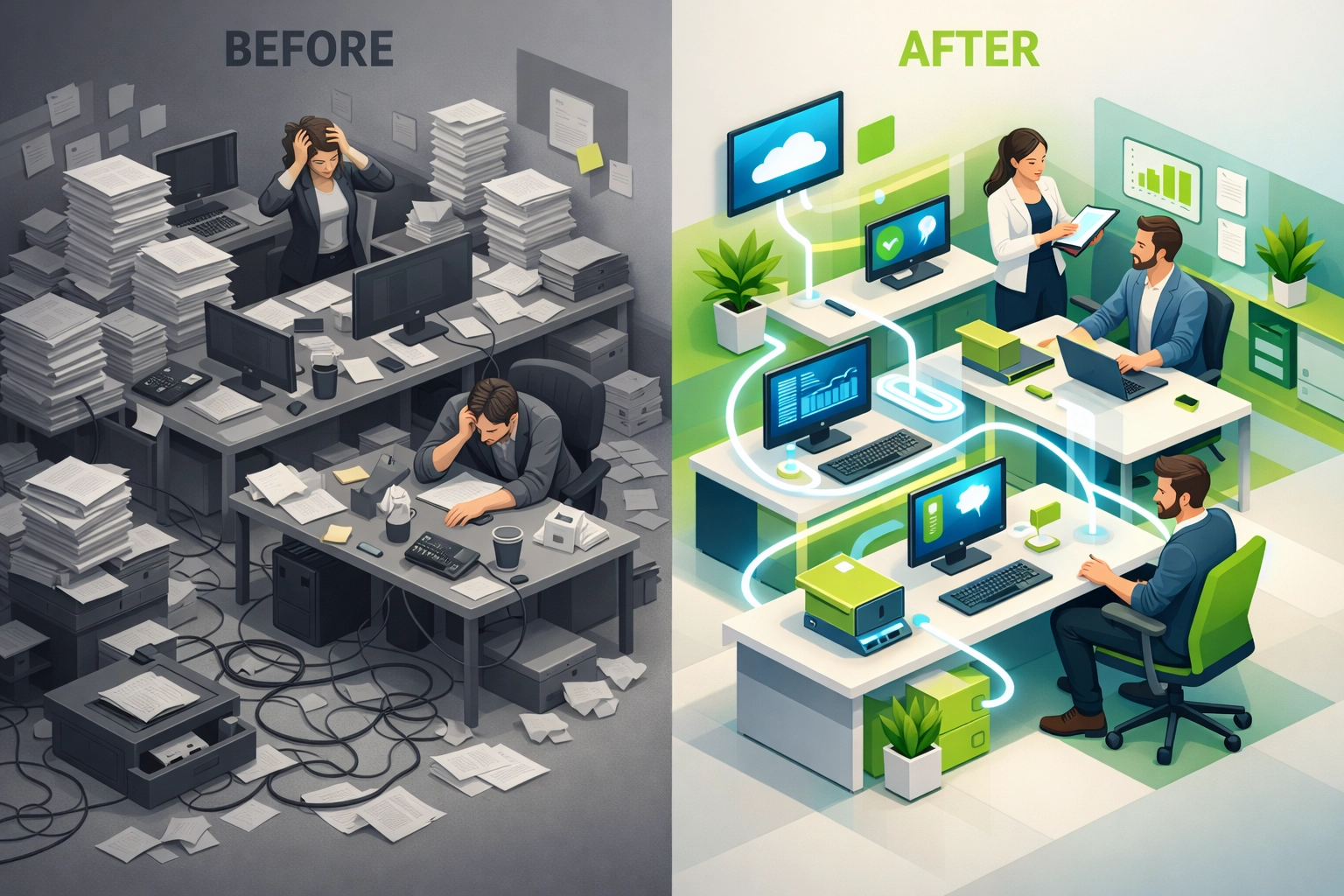
Start with workflow automation. Eliminate operational friction. Recover 40-60 hours monthly. Let your team focus on high-value activities instead of administrative overhead.
Validate with data. After 6 months of automation, you'll have clear metrics on what works, what customers actually need, and where remaining gaps exist.
Build custom software only where it matters. With operational efficiency established and validation data in hand, custom development becomes targeted. You're solving proven problems, not theoretical ones.
At Yotomations, we've seen this pattern repeatedly. Businesses that jump straight to custom software often regret it within 18 months. The ones that automate first, then selectively build custom solutions? They scale profitably while maintaining agility.
Making the Decision: Your 5-Question Framework
Answer these honestly:
-
Does solving this problem directly generate revenue within 90 days? If no, automation probably solves it faster.
-
Are we connecting existing systems or building something entirely new? Connecting? Automate. Building from zero? Consider custom.
-
Will this solution face regulatory scrutiny from external auditors? If yes, custom software might be required. If no, automation works.
-
Do we have 12-18 months of runway to wait for ROI? Most SMBs don't. Automation delivers results within one quarter.
-
Is this solution our core product or an internal process? Internal operations almost always benefit more from automation than custom builds.
Your answers reveal the right path forward.
The Bottom Line
Workflow automation pays off faster for SMBs in virtually every scenario involving internal operations. The ROI appears within 2-3 months, implementation costs are 10-20x lower, and maintenance headaches disappear entirely.
Custom software development has its place: but only after you've automated away operational friction and validated exactly what needs to be built.
The businesses winning in 2026 aren't the ones with the most custom software. They're the ones with the most autonomous, reliable operational systems. Systems that run while you focus on strategy, customers, and growth.
That's what workflow automation delivers. Fast returns. Scalable efficiency. Competitive advantage without the custom software price tag.
Ready to see how automation consulting could transform your operations? Start the conversation.
