
7 Mistakes You’re Making with Workflow Automation (and How to Fix Them Before You Scale)
Efficiency is a trap if you’re building on a swamp.
Most small to medium business owners view workflow automation as a magic wand. They think that by simply plugging in a few tools, their operational headaches will vanish. They expect to "set it and forget it."
That is a dangerous delusion.
At Yotomations, we see it daily: brilliant entrepreneurs scaling their chaos instead of their success. If your manual process is a mess, business process automation will only help you fail faster, more expensively, and at a much larger scale.
Under the leadership of Yaakov (Koby) Oranski, we have refined a philosophy of "Intentional Automation." It isn't about how many tools you can connect; it’s about how many friction points you can eliminate.
Here are the seven most common mistakes businesses make when they automate business processes, and exactly how to fix them before they break your bottom line.
1. Automating a Broken Process
You cannot fix a fundamental logic error with a piece of software.
The most common mistake is taking a manual process that is already inefficient, redundant, or confusing and digitizing it. If your team doesn't know who is responsible for a lead once it hits the CRM, an automated notification won't solve the problem: it will just create more digital noise.
The Fix:
Before you look at a single line of code or a "Zap," map your process on a whiteboard. If you can’t explain the logic to a five-year-old, you aren't ready for custom software development. Simplify first. Remove redundant steps. Once the manual path is lean and effective, then: and only then: do you automate it.
2. The "Frankenstein" Architecture
We’ve seen it all. A business using one tool for lead gen, another for CRM, a third for project management, and a fourth for billing: all held together by fragile, duct-tape integrations. This creates a "Frankenstein" system. When one piece updates, the entire monster dies.

The Fix:
Move toward a modular, centralized architecture. This is why we specialize in n8n automation and Airtable automation. These platforms allow you to build a single "source of truth." Instead of dozens of point-to-point connections, create a hub-and-spoke model where your data lives in one place and your automations branch out from there. It’s cleaner, more resilient, and significantly easier to troubleshoot.
3. Ignoring Data Governance and Hygiene
"Garbage in, garbage out" isn't just a cliché; it’s a financial liability. If your data is messy: duplicate contacts, inconsistent formatting, missing fields: your automations will trigger incorrectly. Imagine sending a "Welcome back, {First_Name}" email where the name field is actually a "LEAD_ID_992."
It looks amateur. It kills trust.
The Fix:
Establish strict data entry standards. Use ai integration services to validate and clean data in real-time. For example, we often build middle-layer scripts that check an email’s validity or format a phone number correctly before it ever reaches your marketing automation tool.
Check out how we handle complex data structures in our portfolio.
4. Forgetting the Human Element
Total automation is a myth.
Many owners try to remove humans entirely from the loop to save on labor costs. However, humans are essential for empathy, complex decision-making, and edge cases. If your marketing automation AI is too rigid, you lose the "human touch" that converts high-ticket leads.
The Fix:
Design "Human-in-the-loop" (HITL) workflows. Automate the 90% of tasks that are repetitive (data entry, scheduling, status updates) and create "checkpoints" for the remaining 10%. Use your automation to prepare the work for a human to approve. This ensures speed without sacrificing quality.

5. Building One Giant, Monolithic Workflow
In the world of automation consulting, we call this the "God Workflow." It’s one single automation that tries to handle the lead intake, the contract, the onboarding, and the invoicing all in one go. If one step fails (like a typo in an email address), the entire chain breaks.
The Fix:
Micro-services. Break your business down into small, independent blocks.
- Workflow A: Lead Intake to CRM.
- Workflow B: CRM to Contract.
- Workflow C: Contract to Onboarding.
By decoupling these processes, you make your business "fault-tolerant." If the onboarding sequence has a bug, your lead intake keeps running perfectly. This is the cornerstone of professional ai automation for small business.
6. Failing to Monitor and Measure ROI
If you can’t measure it, you can’t manage it. Many businesses implement business process automation but have no idea if it’s actually saving them money. They pay for expensive software seats and API calls without tracking the "hours saved" or "error rate reduction."
The Fix:
Build a dashboard. Every automation should report its success or failure to a central monitoring system. We help clients visualize this through custom interfaces that show exactly how many tasks were handled autonomously.
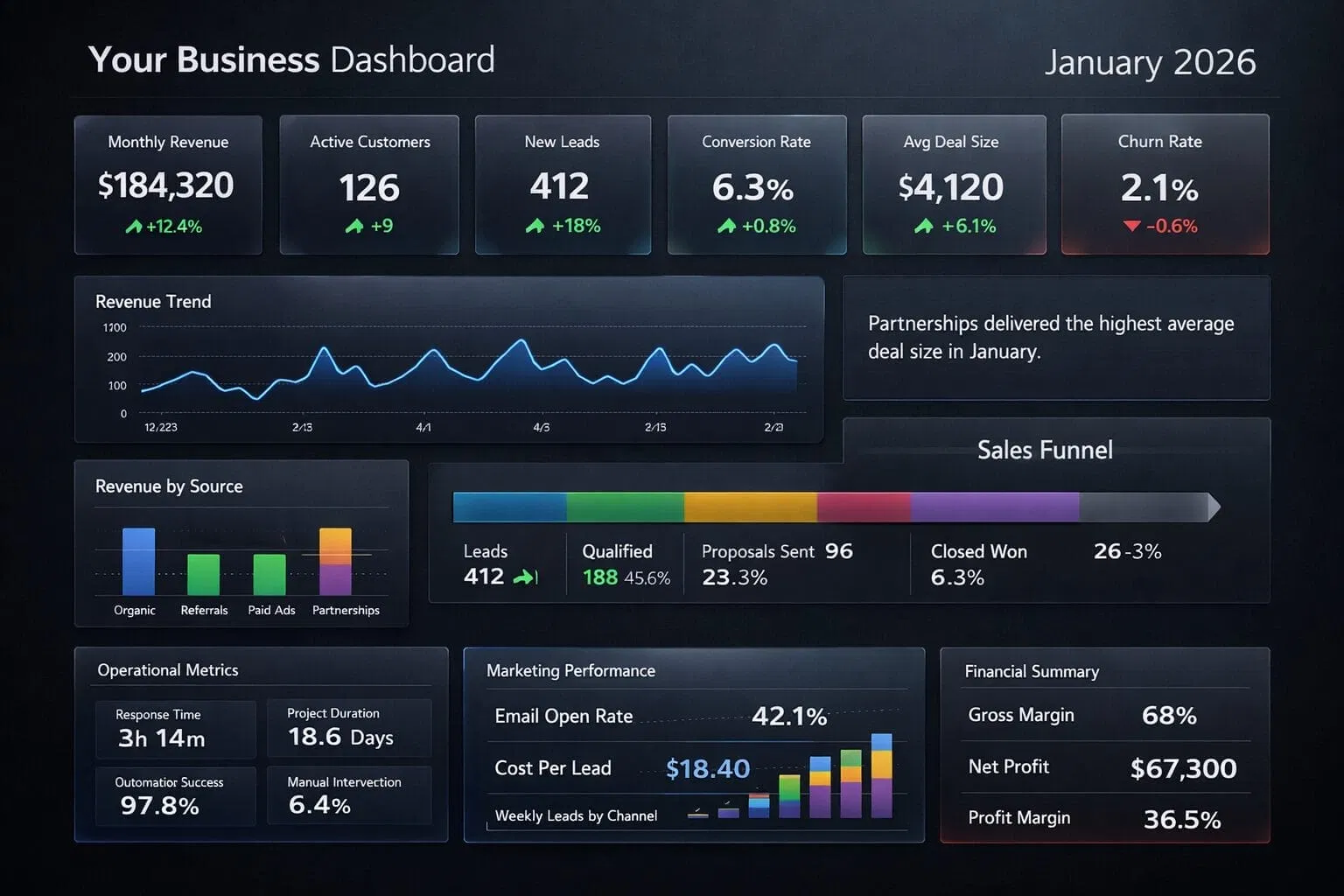
You should be looking at:
- Execution Success Rate: Are your scripts failing?
- Time Savings: How many manual hours did this replace this month?
- Throughput: How many more leads are you processing than before?
For more on how we visualize these insights, explore our Case Studies.
7. Scaling Too Fast Without a Foundation
Growth is the goal, but rapid scaling on a shaky automation foundation is a recipe for a "black swan" event. If your system handles 100 leads a month but crashes at 1,000, you aren't ready to scale. Many businesses use "no-code" tools in ways they weren't intended, leading to massive performance hits when volume increases.
The Fix:
Invest in custom software development early. No-code is great for prototyping, but as you grow, you need the stability of professional-grade code and optimized databases.
At Yotomations, we bridge the gap between "scrappy" and "scalable." We provide ai innovation that grows with you, ensuring that your infrastructure is an asset, not a bottleneck.
How to Get Back on Track
Automation isn't a project; it’s a culture.
If you’ve recognized these mistakes in your own business, don't panic. Most businesses are "accidentally automated": they’ve added tools over time without a master plan. The first step to fixing it is an audit.
Ask yourself:
- Where is the data flowing?
- Where is it getting stuck?
- What happens when a human makes a mistake?
The goal of Yotomations is to help you reach a state of "Simplified Complexity." We take the difficult, technical hurdles of workflow automation and turn them into a seamless background process that allows you to focus on high-level strategy.
Stop Guessing. Start Automating.
Don't let a "broken" workflow hold your business back. Whether you need a simple Airtable integration or a full-scale workflow CRM system, we have the expertise to build it right the first time.
Yaakov Oranski and the team are ready to help you move from manual chaos to autonomous growth.
Ready to fix your workflows?
Explore our Portfolio to see how we’ve transformed businesses just like yours.

