
5 Steps How to Automate Business Processes and Reclaim 20 Hours a Week (Easy Guide for Founders)
You are a founder, not a data entry clerk. Yet, if you look at your calendar, how much of your time is consumed by moving data between spreadsheets, chasing client approvals, or manually updating your CRM? For most small to medium business owners, the answer is "too much."
At Yotomations, we see it daily. High-level talent stuck in low-level loops. Business process automation isn't just a buzzword; it’s the only way to scale without burning out. If you can reclaim 20 hours a week, you aren't just saving time: you are gaining half a work week to focus on high-leverage strategy, sales, and innovation.
Here is the exact 5-step framework we use to automate business processes and build autonomous operations for our clients.
Step 1: Document the Chaos (Before You Automate)
The biggest mistake founders make? Trying to automate a process they don’t actually understand. If your manual process is a mess, an automated version will just be a faster mess.
You need clarity. But don't write a 50-page manual. At Yotomations, Koby Oranski recommends a "Record and Refine" approach.
- Record the Task: Use a tool like Loom to record yourself or a team member performing the task from start to finish.
- The "New Hire" Test: Hand that recording to someone who has never done the task. If they can complete it without asking you a single question, your process is ready for workflow automation.
- Audit Every Click: Note where data is coming from and where it is going. Is it an email? A Slack message? A row in Airtable?
Documentation is the blueprint for your digital workforce. Without it, you are building on sand.
Step 2: Identify High-Impact Candidates
Not every task should be automated. Some things require the "human touch." However, most back-office operations do not. We look for the "Rule-Based Trifecta" when providing automation consulting:
- High Frequency: Does this happen every day? Every hour?
- Rule-Based Logic: Does it follow a strict "If This, Then That" logic? (e.g., If a lead fills out this form, then add them to the CRM and then send this specific email).
- Error-Prone Nature: Does manual entry lead to mistakes?
Focus on ai automation for small business that targets your biggest bottlenecks. Usually, this starts with lead management, invoicing, or data synchronization.
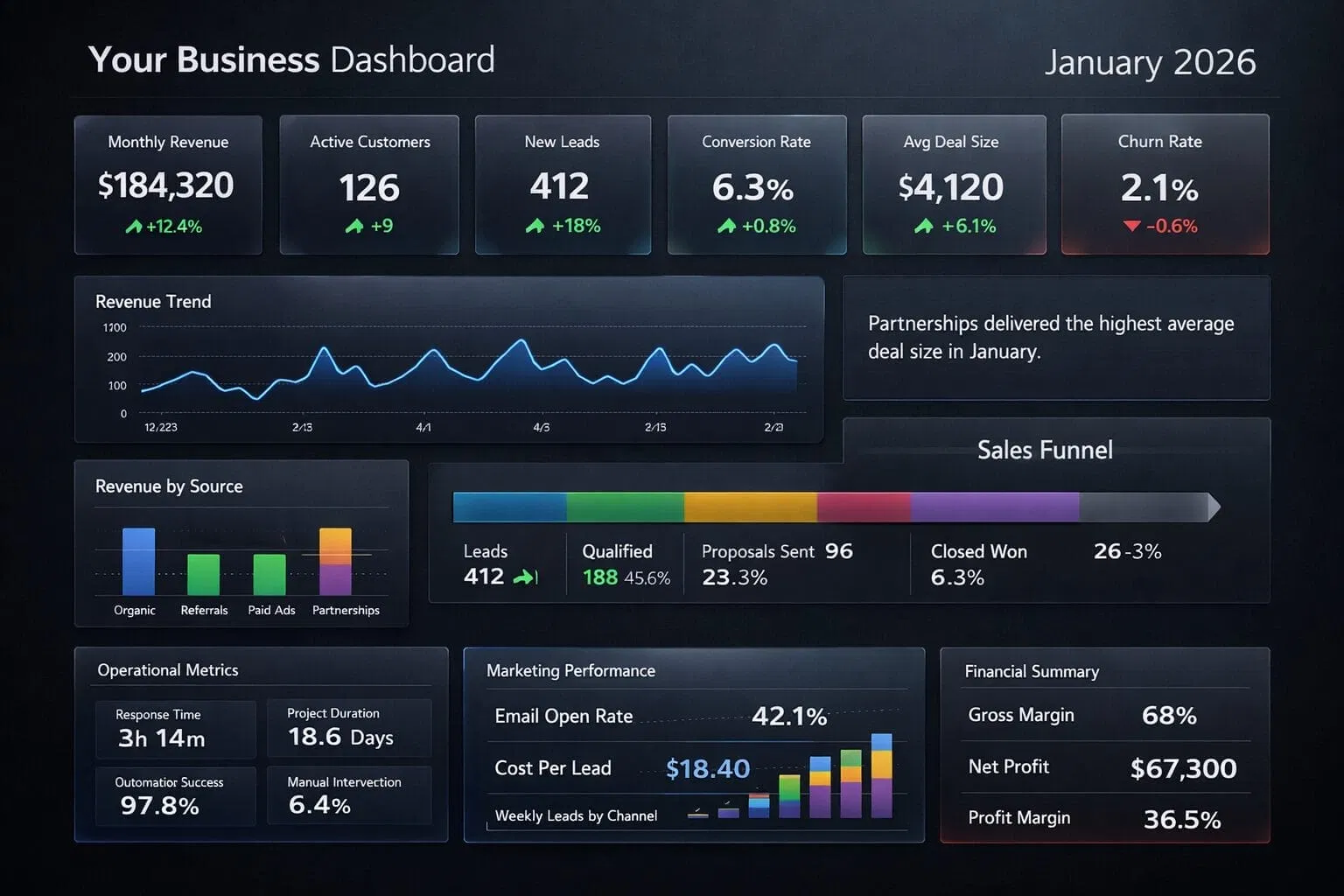
Look at your metrics. If your "lead-to-response" time is lagging because someone has to manually check an inbox, that is a prime candidate for marketing automation ai. Reclaiming time starts by killing the tasks that drain your energy.
Step 3: Map the Ideal Logic
Once you have the documentation, it’s time to architect. Before you touch a single line of code or open an automation tool, you must map the logic.
Workflow automation is about connectivity. You need to define:
- The Trigger: What starts the sequence? (A new stripe payment, a calendar booking, a webhook).
- The Filter: Should every trigger proceed? (Only if the deal size is >$1,000).
- The Action: What actually happens? (Generate an invoice, create a folder in Google Drive, notify the team).

In this stage, we often find that the "ideal" workflow is simpler than the manual one. Automation allows you to bypass redundant steps that humans take out of habit. By utilizing ai integration services, we can even add "decision-making" steps where an AI model analyzes the sentiment of a client email before routing it to the correct department.
Step 4: Choose the Right Tech Stack
This is where the magic happens. You don't need to build everything from scratch, but you do need tools that talk to each other. At Yotomations, we specialize in selecting the right tool for the specific job.
n8n Automation: The Powerhouse
For complex, multi-step workflows, we often turn to n8n automation. It allows for deep logic and self-hosted security, making it a favorite for founders who want professional-grade power without the "per-task" costs of other platforms.

Make & Zapier: The Connectors
For rapid deployment of business process automation, tools like Make.com are invaluable. They connect thousands of apps instantly, allowing us to bridge the gap between your marketing tools and your internal systems.
Airtable: The Relational Engine
Your data needs a home. Airtable automation turns a simple database into a living, breathing command center. It acts as the "source of truth" for your entire automated ecosystem.

Custom Software Development
Sometimes, off-the-shelf tools aren't enough. If your business has a unique proprietary process, custom software development is the only way to ensure 100% fit. We build the "glue" that keeps your business running while you sleep. Check out our portfolio to see how we’ve built these custom bridges for other founders.
Step 5: Implement, Validate, and Scale
Do not flip the switch on everything at once. That is a recipe for a broken business.
- The Pilot Phase: Run the automation for one specific subset of data. For example, automate the onboarding for one specific product line first.
- Parallel Processing: For one week, run the automation alongside the manual process. Compare the results. Does the automation catch things the human missed? Does it make mistakes?
- The Hand-Off: Once validated, "fire" yourself from that task.
- Iterative Expansion: Now that you’ve reclaimed 5 hours, use that clarity to identify the next 5-hour block to reclaim.
Automation is a journey, not a destination. As your business grows, your workflows must evolve. This is where ai automation for small business truly shines: it scales with you without requiring a proportional increase in headcount.
Why Founders Choose Yotomations
Reclaiming 20 hours a week isn't a pipe dream: it’s an engineering problem. Most founders fail at automation because they try to do it in their "spare time."
But you don't have spare time. That’s why you need to automate business processes in the first place.
At Yotomations, we handle the heavy lifting. From automation consulting to full-scale custom software development, we design the systems that let you get back to the work that actually matters. We’ve helped fitness brands, consulting firms, and tech startups turn manual chaos into streamlined, AI-driven engines.

Stop trading your life for manual labor.
If you are ready to see how workflow automation can transform your specific business, explore our services or look at our latest news and case studies.
The technology is ready. The question is, are you ready to get your time back?
Execution. Clarity. Results. That is the Yotomations way.
Ready to start? Let’s build your business-automation roadmap today. Reach out to Koby and the team, and let's find those 20 hours.
