
Why AI Automation for Small Business Will Change the Way You Scale Operations
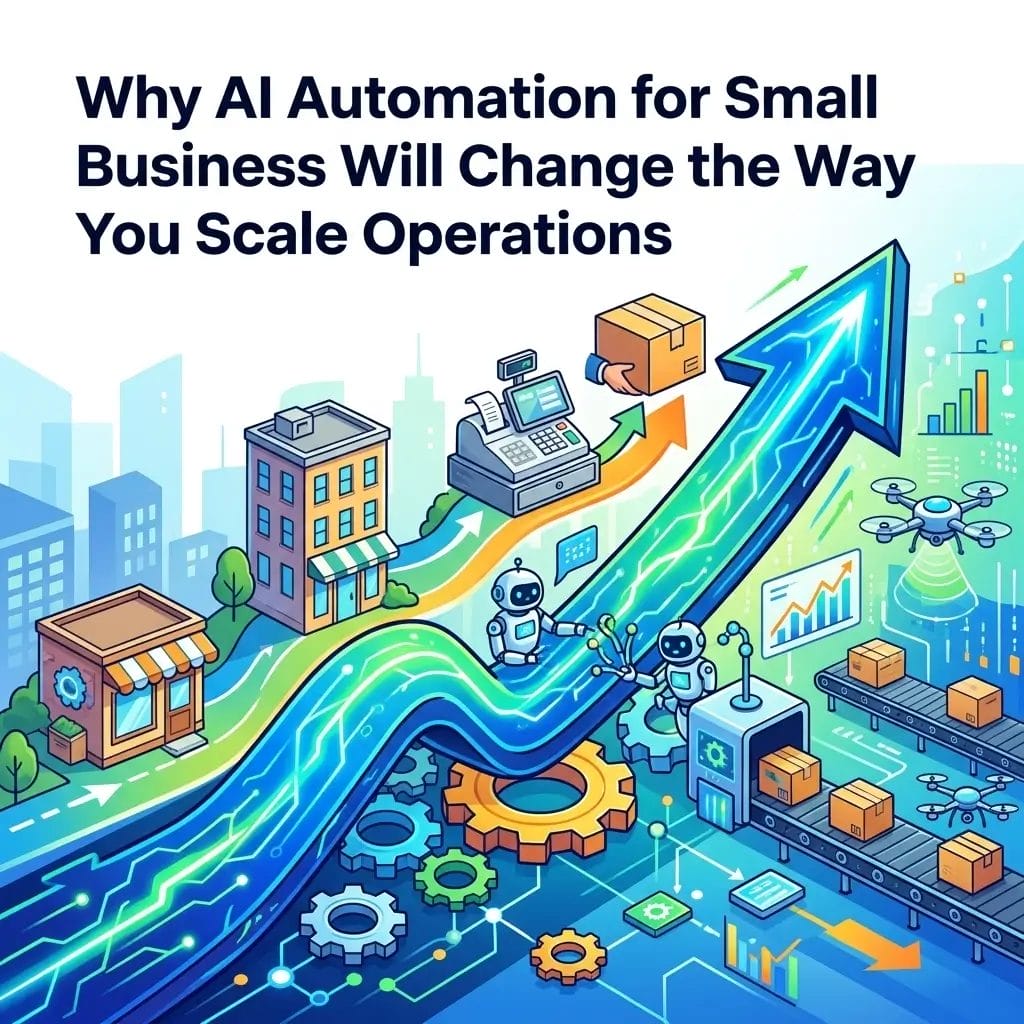
Scaling a small business used to be a math problem that nobody liked solving. More customers meant more support tickets. More sales meant more data entry. More growth meant more hiring. It was a linear trap: to grow your revenue by 2x, you often had to grow your overhead by 2x.
The math has changed.
Today, AI automation for small business is the ultimate leverage. It is the difference between a company that plateaus because its founder is buried in "busywork" and a company that scales exponentially because its operations are autonomous. At Yotomations, we see this transition every day. We aren't just talking about chatbots; we are talking about a fundamental shift in how business is conducted.
The End of Linear Scaling
Traditional scaling is labor-intensive. When a business hits a certain threshold, the owner faces a choice: stay small and manageable, or hire a fleet of managers and assistants to handle the administrative weight of growth. This "middle zone" is where most small businesses die. The overhead eats the profit.
Business process automation changes the trajectory. Instead of hiring a person to move data from an email to a CRM, you build a bridge. Instead of manually following up with leads, you deploy marketing automation AI.
The result? You scale the output without scaling the headcount. You achieve enterprise-level efficiency on a boutique budget.
The Core Pillars of Modern Automation
To understand why this is transformative, you have to look at the specific technologies driving the change. We aren't looking for "cool" tools; we are looking for reliable systems that produce ROI.
1. Workflow Automation and Orchestration
Most small businesses are a collection of "islands." Your email doesn't talk to your project management tool. Your accounting software doesn't know what your sales team is doing. This friction is where time disappears.
Using platforms like n8n automation or Make, we create "connective tissue" between your apps. When a lead fills out a form, the system automatically vets the lead, creates a profile in your CRM, alerts the sales head on Slack, and sends a personalized (AI-generated) introductory email.
Execution. No human intervention required.

2. Centralized Data with Airtable
If your data is scattered across three different spreadsheets and a dozen sticky notes, you can't scale. Airtable automation allows us to build custom databases that act as the "brain" of your company.
At Yotomations, we often use Airtable as a backend to trigger complex workflows. It’s not just a place to store names; it’s a command center. When a status changes in Airtable, the AI knows to trigger the next step in your fulfillment process. This is the foundation of custom software development: building tools that fit your specific business logic, not forcing your business to fit into a generic SaaS box.
Why "Off-the-Shelf" Isn't Enough
Many business owners try to solve their scaling problems by subscribing to ten different "AI apps." Six months later, they have a $1,000 monthly software bill and a team that is more confused than ever.
Generic software is built for the "average" user. Your business isn't average. Your processes are your competitive advantage. This is where automation consulting and ai integration services become essential.
We look at your specific bottlenecks. Are you spending four hours a day on client onboarding? We build a custom discovery setup. Are you struggling to track marketing ROI? We implement a business marketing report system that updates in real-time.

Data-Driven Decision Making at Speed
One of the biggest hurdles to scaling is the "fog of war." Owners often make decisions based on gut feeling because getting real data takes too long. By the time the monthly report is ready, the information is already stale.
AI automation provides a "live" look at your vitals. When you automate business processes, every action leaves a digital footprint that can be visualized instantly.
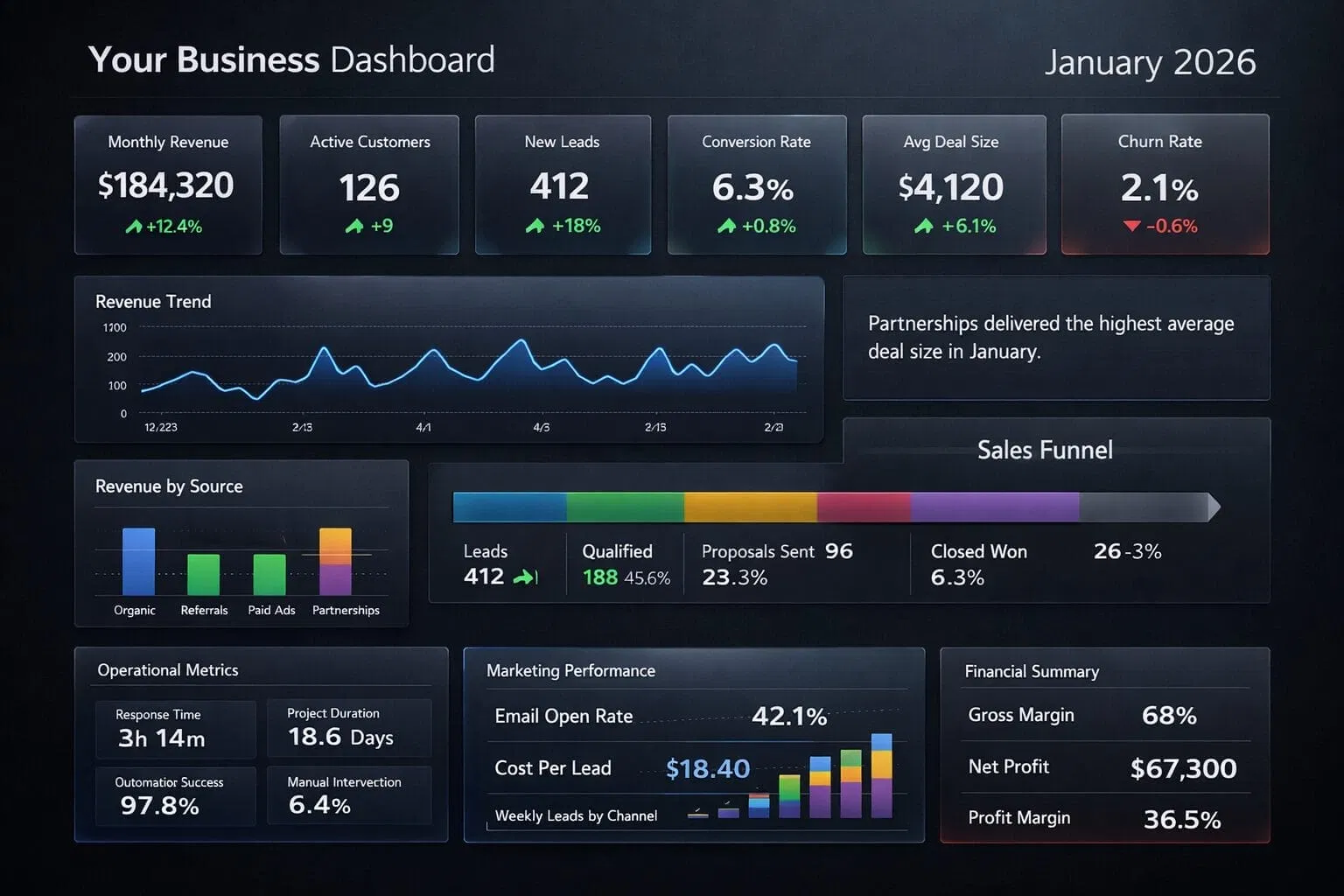
Imagine opening a dashboard and seeing your cost-per-lead, your fulfillment speed, and your customer churn rate updated to the second. This isn't just "nice to have"; it’s a weapon. It allows you to pivot faster than your larger, slower competitors.
The Productivity Multiplier: Marketing and Sales
Scaling sales is usually the most expensive part of growth. AI is flipping the script. Marketing automation AI allows a single person to manage a campaign that would have previously required a five-person agency.
- Content Generation: Use AI to draft blogs, social posts, and newsletters based on your brand voice. (Learn more about content generation use cases).
- Lead Scoring: AI can analyze incoming leads and prioritize them based on their likelihood to close, ensuring your sales team only talks to "hot" prospects.
- Customer Personalization: Deliver a "white-glove" experience to 1,000 customers simultaneously by using AI to tailor communications based on their specific behavior and history.
Breaking Down the Barriers to Entry
Historically, this level of automation was reserved for companies with seven-figure IT budgets. The barrier to entry was high.
Not anymore.
The rise of low-code/no-code tools combined with Large Language Models (LLMs) has democratized power. A small plumbing company or a boutique law firm can now deploy the same level of operational sophistication as a Silicon Valley startup.
The only requirement is a shift in mindset. You have to stop viewing automation as a "tech project" and start viewing it as infrastructure. Just as you wouldn't run a modern office without electricity or internet, you shouldn't run a growing business without an automation layer.

How to Start Scaling (The Right Way)
The biggest mistake we see is "random acts of automation." An owner tries to automate one tiny thing, fails because the tool is too complex, and gives up.
Scaling requires a roadmap:
- The Audit: You cannot automate what you do not understand. We start with AI Audits to map out your current workflows and identify where the "leaks" are.
- The Foundation: Clean up your data. Move away from fragmented docs and into a centralized system like Airtable.
- The Integration: Use ai integration services to connect your core tools (CRM, Email, Accounting).
- The Optimization: Once the pipes are connected, we add the AI "brain" to handle decision-making and content generation.
The Bottom Line
AI automation is not about replacing your team; it’s about liberating them. It’s about taking the 40% of their day spent on soul-crushing repetitive tasks and giving it back to them for high-value work.
When your team is focused on strategy and your systems are focused on execution, you don't just scale: you thrive.
At Yotomations, we specialize in building these engines. We take the complexity of custom software development and deliver simple, automated results. Yaakov Oranski and our team are dedicated to helping small businesses stop trading time for money and start trading systems for growth.
The future of scaling isn't more people. It's better systems.
Ready to see how your operations can be transformed? Read more about us or dive into our case studies to see automation in action. The gap between where you are and where you want to be is paved with the processes you choose to automate today.
