
The Proven Workflow Automation Framework: Why Your Current Processes Are Costing You Clients

Most small to medium business owners are bleeding money.
They don't see it because it isn't a line item on a balance sheet. It’s the "hidden tax" of manual labor. It’s the three hours your operations manager spends syncing spreadsheets. It’s the lead that went cold because your follow-up wasn’t instant. It’s the human error in a manual invoice that costs you a client's trust.
In 2026, manual work isn't just a nuisance. It’s a competitive liability.
At Yotomations, we see it every day. Founders are working in their business rather than on it. They are the bottleneck. If you want to scale without ballooning your headcount, you need a system that works while you sleep. You need business process automation.
Here is the proven framework we use to help our clients reclaim hundreds of hours every year.
The Cost of the "Status Quo"
Before we look at the solution, we have to look at the damage. Statistics from 2026 show that automating just five to ten repetitive daily tasks can save an employee up to 10 hours per week.
For a team of five, that’s 2,600 hours a year reclaimed.
What is your time worth? If you value your time at $100/hour, your "manual process habit" is costing you over a quarter-million dollars annually.
Execution. That is the difference between a stagnant business and a market leader. Leaders don't wait for "more time." They build it using ai automation for small business.
Step 1: The Automation Audit (Identify & Prioritize)
You cannot automate business processes that you don’t understand. The biggest mistake we see is "random acts of automation": buying a tool because it looks shiny, then trying to force it into a broken workflow.
Stop. Audit.
List every recurring task in your business. Focus on the ones that are:
- Rule-based: Does it follow a "if this, then that" logic?
- High-frequency: Does it happen daily or weekly?
- Low-creativity: Does it require a human brain, or just a human pair of hands?
We call this "The Admin Kill List." Your goal is to move the highest-frequency, lowest-value tasks to the top. This is where automation consulting provides the most immediate ROI.
Step 2: Mapping the "Perfect Path"
Once you have your list, you must map the workflow. Documentation is the foundation of custom software development.
If a process is messy when manual, it will be a disaster when automated. You are essentially teaching a machine how to do your job. If the instructions are vague, the machine will fail.
- Trigger: What starts the process? (An email? A form submission? A date?)
- Action: What specific steps occur next?
- Logic: Are there branches? (e.g., If the lead is from LinkedIn, send to Folder A; if from Google, send to Folder B.)
- Outcome: What is the final definition of "done"?

Step 3: Architecting the Solution (The Stack)
This is where the magic happens. We don't believe in one-size-fits-all software. We build custom software solutions that integrate the best tools on the market.
Our core "Power Trio" usually includes:
- n8n Automation: Unlike closed platforms, n8n allows for complex, fair-cost logic that scales with your business. We use n8n automation to connect your entire ecosystem.
- Airtable Automation: Think of Airtable as your business's central nervous system. It’s more than a spreadsheet; it’s a relational database that powers workflow-crm-systems.
- Marketing Automation AI: We integrate AI to handle the "thinking" parts of the workflow: summarizing emails, qualifying leads, or generating personalized content for your audience.
By using ai integration services, we ensure your stack isn't just a series of silos, but a unified engine.

Step 4: Refine and Stress-Test
Zero-touch. That is the goal.
However, you don't achieve zero-touch on day one. We implement a "Beta Phase" for every automation. We run the automation alongside your manual process for one week.
- Does the data sync correctly?
- Are the notifications reaching the right people?
- Where does the logic break?
Refining the system is just as important as building it. At Yotomations, we provide ongoing support to ensure that as your business evolves, your workflow automation evolves with it.
Step 5: Measure, Scale, and Thrive
How do you know if it's working? You look at the data.
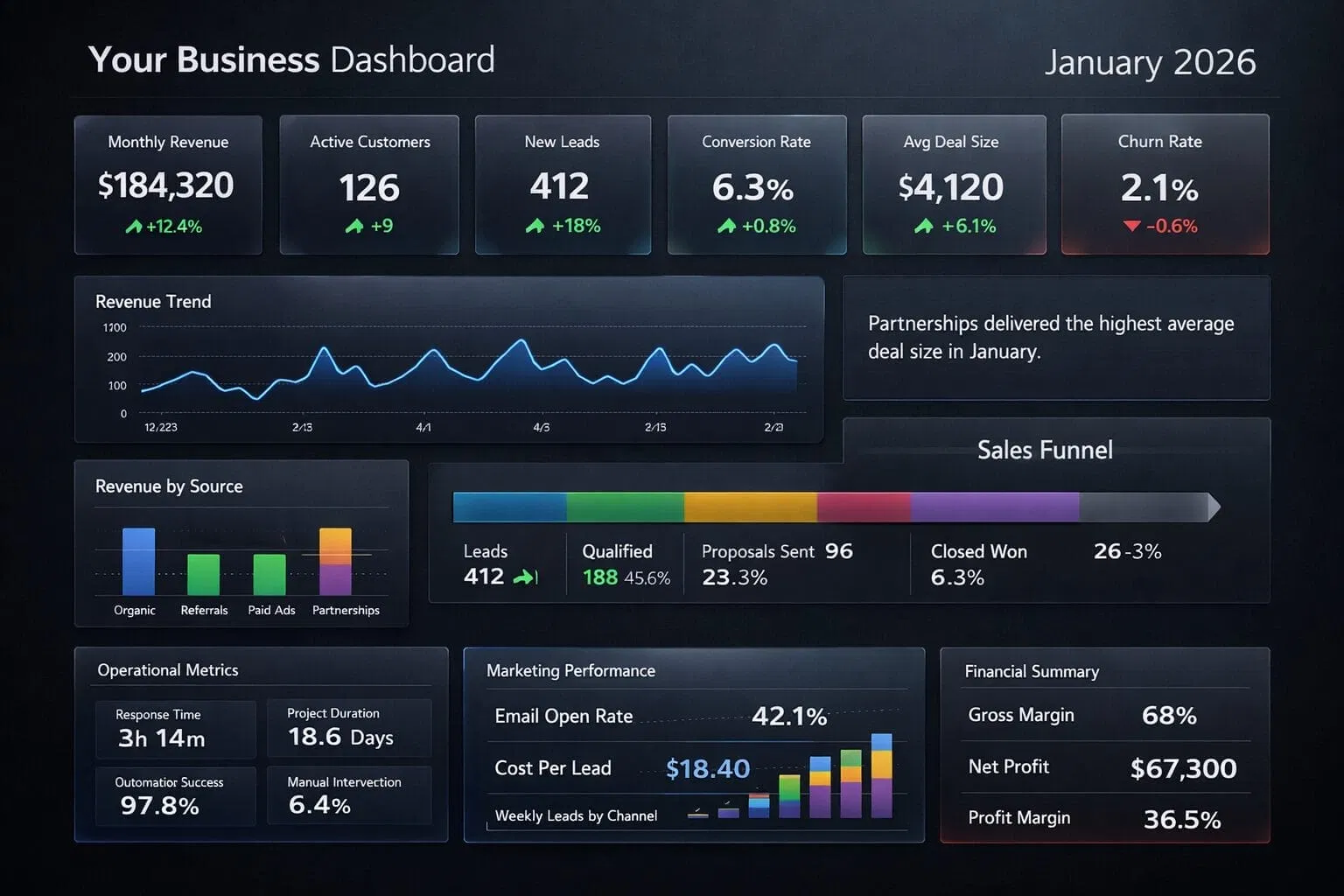
We integrate custom dashboards: similar to our business-metrics-dashboard: to track the health of your automated systems. We look at:
- Cycle time: How much faster is the process now?
- Error rate: Did we eliminate the "human touch" mistakes?
- Lead conversion: Is our marketing automation ai catching more opportunities?
When you see the results in black and white, the next step is obvious: Scale. You take the time and money you saved and reinvest it into growth.
The Yotomations Edge
At Yotomations, we don't just sell software. We sell clarity. We sell freedom.
We’ve helped businesses transform their operations: from automating Yelp Ads intake forms to building full-scale business automation systems that allow founders to step back from the day-to-day.
Your current processes are costing you clients. Every minute you spend on an administrative task is a minute you aren't talking to a high-value prospect.
Stop losing. Start automating.
Ready to build your business engine? Contact Yotomations today and let’s talk about your "Kill List."
