
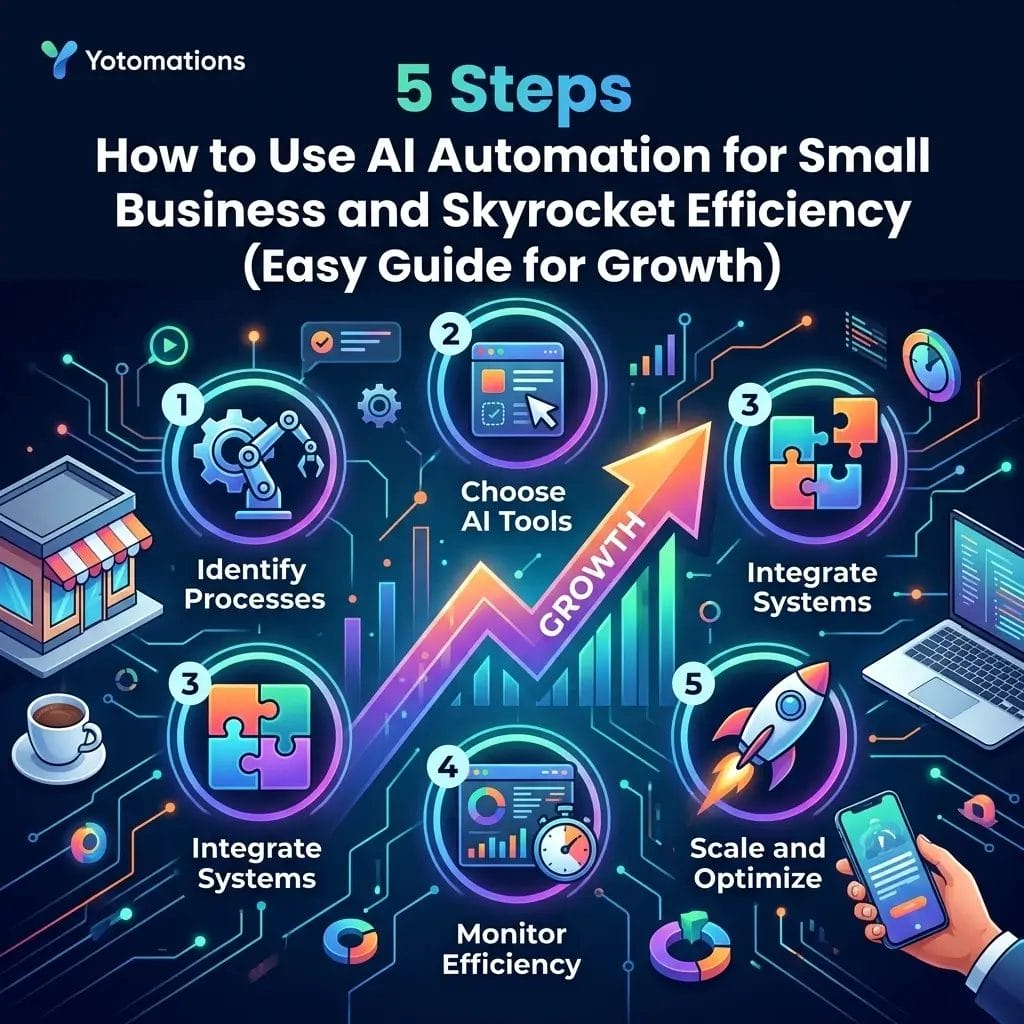
5 Steps How to Use AI Automation for Small Business and Skyrocket Efficiency (Easy Guide for Growth)
Efficiency is no longer a luxury. For the modern small business owner, it is a survival requirement. You are likely juggling lead generation, customer support, and internal operations while trying to maintain a strategic vision for growth. Most entrepreneurs fail because they get bogged down in the "how" rather than the "why."
AI automation for small business isn't about replacing your team. It is about augmenting their output. It is about taking the repetitive, soul-crushing tasks off their plates so they can focus on high-value human interaction. At Yotomations, we see it every day: businesses that embrace business process automation scale faster, stay leaner, and ultimately win their markets.
Here is your five-step blueprint to leverage AI and transform your operations.
Step 1: Identify Your "Energy Vampires"
The first step isn't technical. It’s observational. You must identify the processes that are killing your momentum. We call these "Energy Vampires": tasks that are repetitive, rule-based, and contribute little to your strategic goals but take up hours of your week.
Common targets for workflow automation include:
- Manual data entry between your CRM and accounting software.
- Drafting standard email responses for common customer inquiries.
- Scheduling social media posts and tracking engagement.
- Generating and sending invoices based on project completion.
Yaakov (Koby) Oranski, our CEO, often emphasizes that if a task can be described as a flowchart, it can likely be automated. Look at your daily calendar. Where are you clicking the same buttons over and over? That is your starting point. You aren't looking for complexity yet; you are looking for volume. High volume plus low complexity equals a perfect automation candidate.
Step 2: Start Small with a Single, High-Impact Use Case
Many business owners make the mistake of trying to overhaul their entire operation overnight. This leads to complexity collapse. Instead, select one specific use case that offers an immediate "win."
A classic example is the client discovery and intake process. Instead of manually emailing back and forth to schedule a call and collect data, you can build a system that captures lead information, classifies the lead using AI, and automatically populates your CRM. You can see how we handled this for our clients in this case study on client discovery setup.

Focusing on a single use case allows you to learn the mechanics of ai integration services without overwhelming your staff. Once you see a lead enter your system and get handled by an autonomous agent without you lifting a finger, the mindset shift happens. You stop seeing AI as a toy and start seeing it as a digital employee.
Step 3: Build the Architecture of Your Workflow
Once you have identified your use case, it’s time to build. In the world of custom software development and automation, we typically follow a three-part structure: Trigger → AI Processing → Action.
- The Trigger: An event that starts the process (e.g., a new email, a form submission, or a scheduled time).
- AI Processing: This is where the "brain" comes in. Tools like ChatGPT or specialized LLMs analyze the data. They can summarize a long email, classify a support ticket as "Urgent," or extract data from a PDF invoice.
- The Action: The final output. This could be updating a row in Airtable, sending a notification via Slack, or drafting a reply in your CRM.
For robust, enterprise-grade logic, we often recommend n8n automation or Airtable automation. These platforms allow for complex branching logic that simple "if-this-then-that" tools cannot handle.

By utilizing ai automation for small business, you create a "zero-touch" environment. Your data flows where it needs to go, when it needs to go there, with zero human intervention.
Step 4: Test, Optimize, and Gather Feedback
Automation is not "set it and forget it." It is "build, measure, and refine."
Before you roll out an automated system to your entire customer base, run it in a "shadow mode." Let the AI draft responses, but keep them in a "Drafts" folder for human review. This allows you to verify the accuracy of your marketing automation ai and ensure the brand tone remains professional and consistent.
Ask your team:
- Is the automation saving you time?
- Is the data appearing in the right place?
- Are there edge cases we missed?
Optimization is where the real ROI happens. A process that was 80% efficient in week one can reach 99% efficiency by month three through constant refinement. If you need help identifying where these improvements can be made, our team provides comprehensive AI Audits to pinpoint the exact levers for growth.
Step 5: Measure Your Results and Scale
The final step is to turn your successful pilot into a company-wide standard. To do this effectively, you need data. You need to see the impact of your business process automation on your bottom line.
Track metrics such as:
- Time Saved: How many hours per week are no longer spent on manual tasks?
- Response Time: How much faster are leads being contacted?
- Error Rate: Has the frequency of data entry errors decreased?
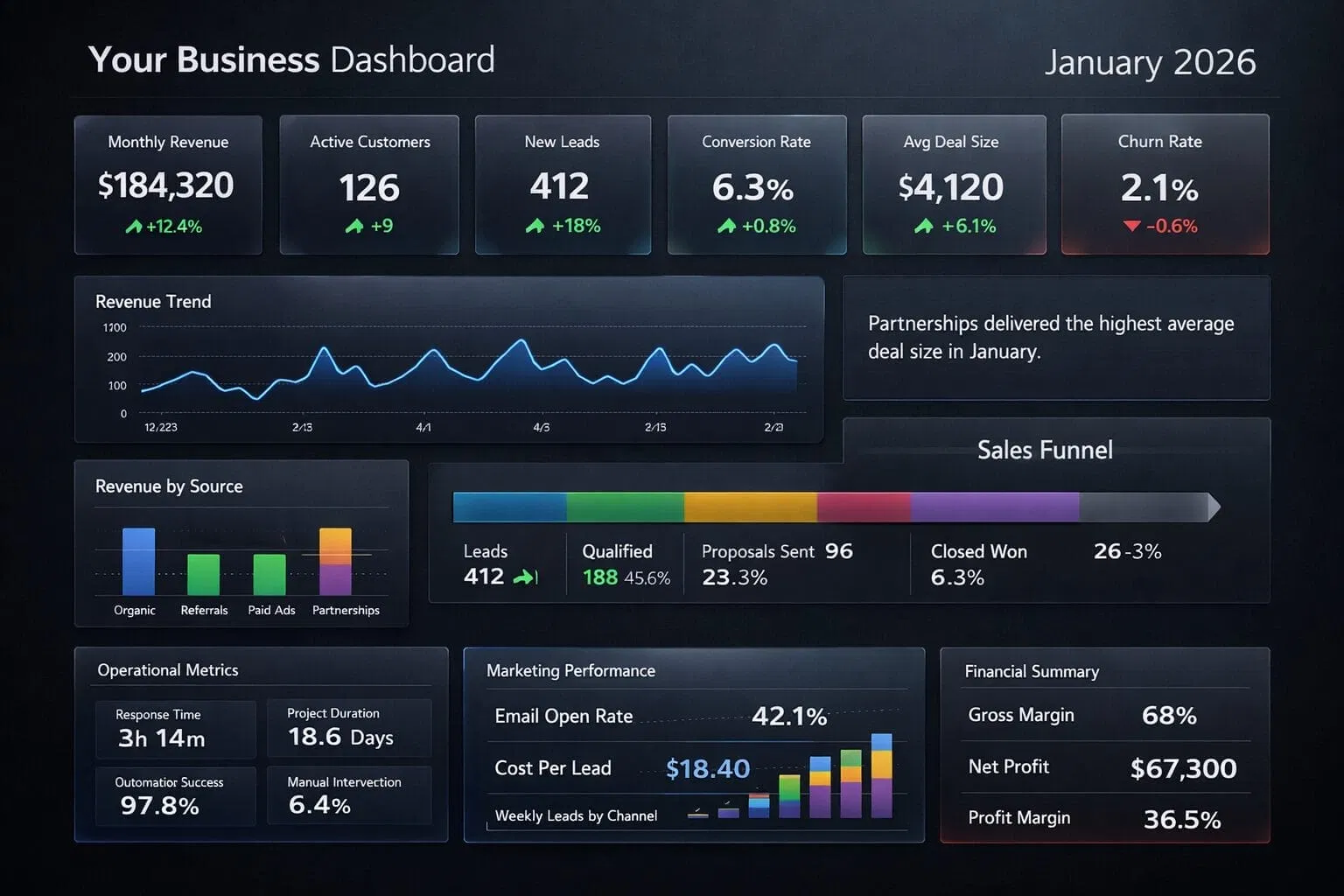
Once you have proven the value in one department: say, Sales: move to Operations. Then to Finance. Then to HR. This phased approach, supported by automation consulting, ensures that your growth is sustainable and that your infrastructure can handle the increased volume that comes with efficiency.
By the time you reach this stage, you aren't just a small business owner anymore; you are the architect of an autonomous system.
The Yotomations Advantage
At Yotomations, we don't just talk about automation; we build it. From content generation to complex CRM integrations, we specialize in turning manual friction into digital flow.
The gap between businesses that use AI and those that don't is widening. Don't get left behind by legacy thinking. Whether you need a custom tool like our Yelp Dashboard or a full-scale overhaul of your workflows, the time to act is now.
Execution is everything. Start with step one today, and by this time next year, you’ll be running a business that works for you, rather than you working for it.
Ready to skyrocket your efficiency? Contact us to discuss how we can build your custom automation roadmap.
