
AI Automation for Small Business Matters: Why Your Competitors Are Suddenly Scaling Faster
Your competitors didn’t suddenly discover a secret well of talent. They didn’t double their marketing budget overnight. And they certainly didn't find a way to add more hours to the day.
They simply stopped acting like it was 2015.
While you are still battling spreadsheets and manual data entry, your rivals are leveraging business process automation to build an invisible workforce. They are scaling faster because their overhead isn't tied to their headcount. In 2026, the gap between the "automated" and the "manual" is no longer a crack; it's a canyon.
At Yotomations, we see it every day. Small to medium-sized businesses (SMBs) that embrace ai automation for small business aren't just saving time. They are fundamentally changing the math of their operations.
The Illusion of the "Hard Worker"
For decades, the "hustle" was the primary engine of small business. If you wanted to grow, you worked harder. You stayed later. You hired another assistant to handle the overflow.
That model is dead.
Today, "working harder" is often a symptom of systemic failure. If your team is spending four hours a day moving data from an email into a CRM, they aren't working; they are behaving like poorly designed software. Your competitors have realized that workflow automation can handle these repetitive, rules-based tasks with zero errors and zero fatigue.
When you automate business processes, you liberate your best people to do what humans do best: strategy, creative problem-solving, and high-level relationship building.
1. Reclaiming the Clock with Workflow Automation
Time is the only resource you can’t buy back. Yet, most SMB owners spend it like it’s infinite.
Consider the "Administrative Tax." Every time a lead comes in, someone has to tag it, assign it, send a follow-up email, and set a calendar reminder. If that takes ten minutes and you get twenty leads a day, that’s over three hours of manual labor.
Your competitors are using n8n automation or Make to handle this in milliseconds.
- Lead Capture: Instantaneous.
- Qualification: Handled by AI based on pre-set criteria.
- Scheduling: Done via autonomous agents that sync with calendars.
- Nurturing: Marketing automation ai sends personalized content based on the lead's specific pain points.
By the time you’ve opened your first spreadsheet of the day, your competitor has already moved three leads through the top of their funnel without a single human touching the process.

2. Operating Costs: The Leaner, Meaner Advantage
The old way of scaling meant that as revenue grew, expenses grew in tandem. You needed more office space, more licenses, and more payroll.
Custom software development and AI integration have flipped the script. We are now in the era of "Linear Growth, Exponential Efficiency."
By utilizing ai integration services, businesses are unifying their tech stacks. Instead of paying for ten different tools that don't talk to each other, they are building custom ecosystems where data flows seamlessly. This reduces the "subscription bloat" and eliminates the need for "bridge hires": people whose only job is to manage the friction between different departments.
Check out how we compare custom software development vs. workflow automation to see which fits your current budget.
3. Data-Driven Decisions vs. "Gut Feeling"
Most small businesses operate on vibes. They "feel" like a product is doing well. They "think" a certain marketing channel is working.
Your competitors are using airtable automation and custom dashboards to see the cold, hard truth in real-time. When you integrate your sales, marketing, and operational data into a centralized hub, patterns emerge that the human eye would miss.
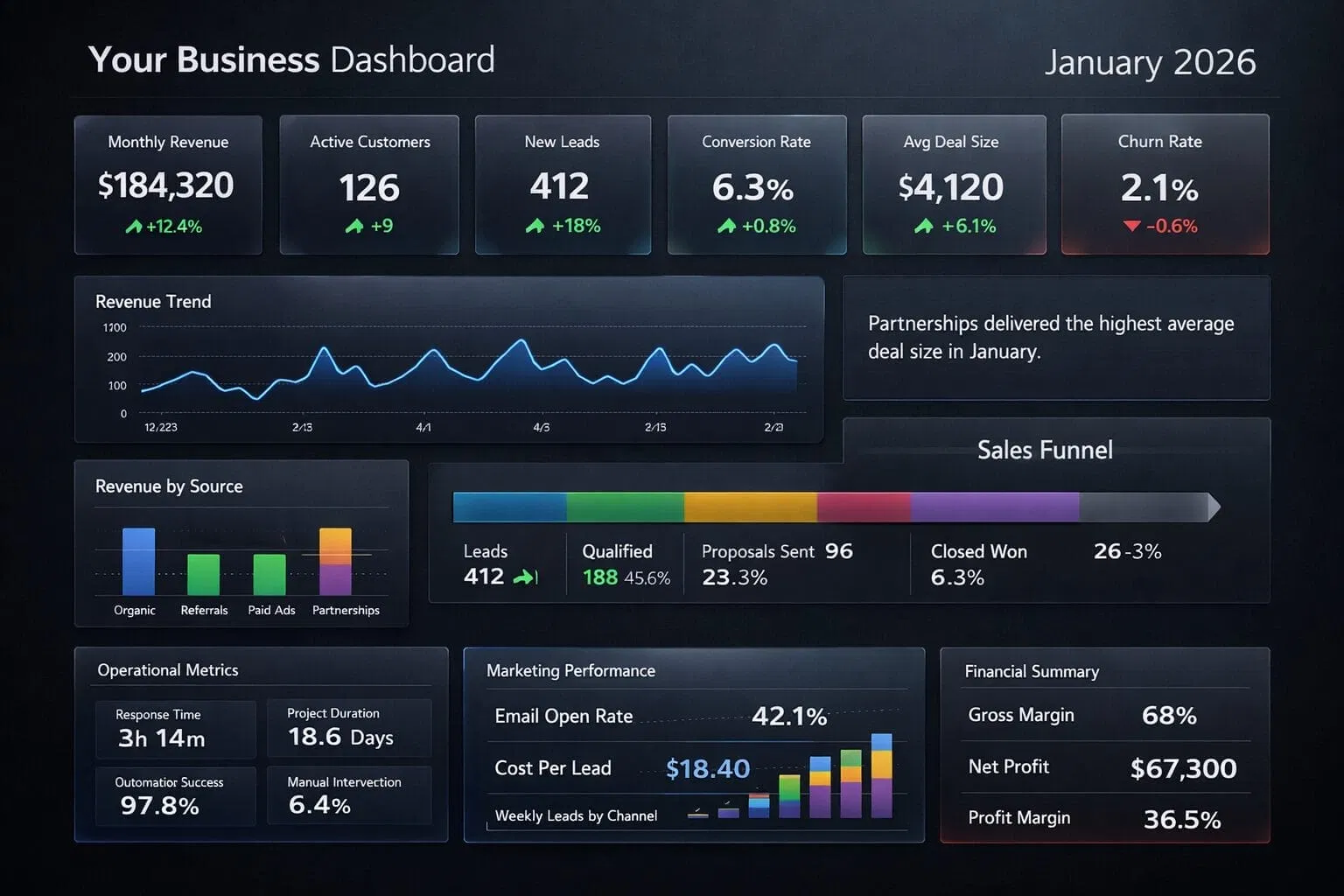
With a custom analytics dashboard, you aren't guessing. You know exactly:
- Which leads are likely to churn.
- Which automated workflows are saving the most billable hours.
- Where the bottlenecks are in your fulfillment process.
As Yaakov (Koby) Oranski often tells our clients: "You can't manage what you don't measure, and you can't measure what you haven't automated." For a deeper dive into this, see our article on why every SMB needs automation consulting in 2026.
4. The 24/7 Customer Experience
In 2026, the "9 to 5" is a relic. Customers expect answers at 2:00 AM on a Sunday. If you aren't there to answer, they’ll find someone who is.
This is where your competitors are really pulling ahead. They aren't staying up all night; they are using AI-driven customer service agents. These aren't the clunky chatbots of 2020. These are sophisticated tools that understand context, tone, and intent.
- They resolve 70% of common queries instantly.
- They handle booking and rescheduling without human intervention.
- They escalate complex issues to a human agent with a full summary of the interaction.
To the customer, the business feels massive, professional, and incredibly responsive. In reality, it might be a team of five people leveraging high-end automation consulting.
5. Scaling Without Breaking
The most dangerous time for a small business is during a growth spurt. When orders double overnight, manual systems break. Files get lost. Customers get ignored. Staff gets burnt out.
Automation provides the "elasticity" needed to scale. A workflow designed to handle 10 tasks a day can usually handle 1,000 tasks a day with minimal adjustment.
Your competitors are building their businesses on custom software development foundations that are designed for where they want to be in three years, not just where they are today. They aren't afraid of a 300% increase in lead volume because they know their systems can take the hit.

How to Close the Gap: A 3-Step Action Plan
If you feel like you’re falling behind, don't panic. The beauty of AI in 2026 is that it is more accessible than ever. You don’t need a Silicon Valley budget to start.
Step 1: Identify the "Friction Points"
Audit your day. Where are you or your team doing "Ctrl+C, Ctrl+V" work? Any task that is repetitive and follows a set of rules is a candidate for workflow automation. Start there. Don't try to automate your entire business at once. Pick the one task that causes the most headache.
Step 2: Choose Your Stack
You have two main paths. You can use low-code tools like Airtable and n8n to stitch together existing apps, or you can go the route of custom software development for a truly proprietary advantage.
We’ve broken down the pros and cons here: Airtable Automation vs. Custom Software.
Step 3: Implement and Iterate
Automation is not a "set it and forget it" project. It’s an evolution. Start with a small pilot, measure the results, and then expand. This is where automation consulting becomes invaluable: having an expert eye to ensure your workflows are optimized for ROI, not just "cool factor."
The Risk of Staying Manual
The market is no longer forgiving of inefficiency. As AI continues to lower the barrier to entry for new competitors, the only way to defend your position is through operational excellence.
If you continue to rely on manual processes, your margins will continue to shrink while your competitors' margins expand. They will have more capital to reinvest, more time to innovate, and a better reputation with customers.
At Yotomations, we specialize in helping SMBs stop the bleeding and start the scaling. Whether it’s through marketing automation ai or a full-scale custom software development project, our goal is simple: simplify, automate, and thrive.
Don't let another quarter go by while your competitors pull further ahead. The tools are here. The technology is proven. The only thing missing is your decision to execute.

Ready to see what's possible? Explore our portfolio to see how we've helped other businesses transform their operations through the power of intelligent automation.
