
5 Steps to Use AI Integration Services and Scale Your Startup (Easy Guide for Founders)
Scaling a startup is a race against time and resources. As a founder, you are likely wearing ten different hats, jumping from sales calls to product roadmaps while trying to keep your burn rate under control. The bottleneck isn't your vision; it’s your manual operations.
In 2026, the gap between a struggling startup and a market leader is defined by one thing: AI integration services.
At Yotomations, we see it daily. Founders try to "throw more people" at a problem that should be solved with code. Scaling doesn't mean hiring 50 people to handle data entry. It means building an autonomous infrastructure that breathes efficiency. If you want to multiply your output without multiplying your headcount, you need a roadmap for business process automation.
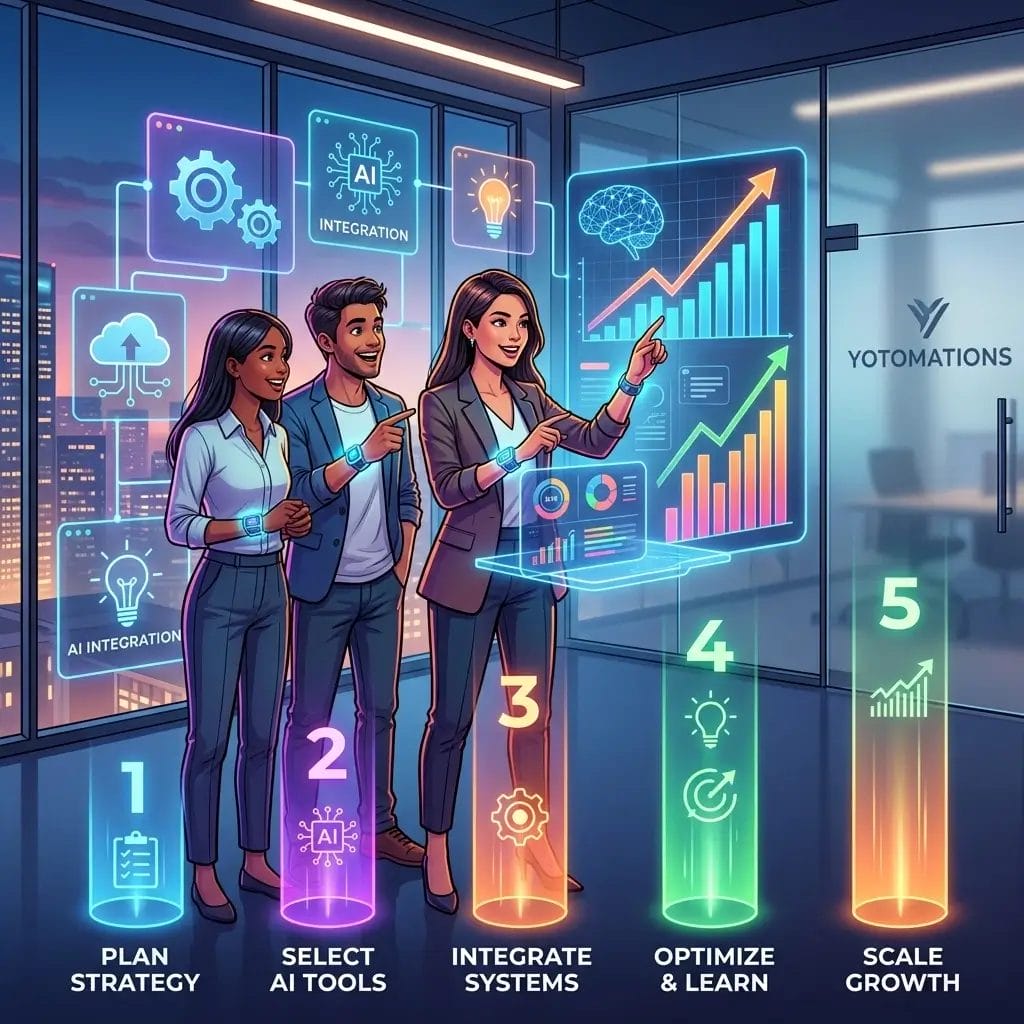
Here is the 5-step guide to leveraging AI integration to scale your startup.
Step 1: Diagnose the Bottlenecks and Set SMART Goals
You cannot automate what you do not understand. The first mistake most founders make is chasing "AI" as a buzzword rather than a utility.
Start by auditing your calendar. Where is your team losing the most time? Is it lead qualification? Customer support tickets? Data synchronization between your CRM and your project management tools? Automate business processes that are repetitive, high-volume, and low-complexity first.
Once you identify the "where," define the "what" using SMART goals:
- Specific: Instead of "improve support," aim to "automate 60% of Tier 1 support queries."
- Measurable: Reduce the time spent on manual invoice generation by 15 hours per week.
- Achievable: Don't try to build an AGI. Focus on a narrow workflow automation use case.
- Relevant: Ensure the automation directly impacts your North Star metric (e.g., CAC, LTV, or Churn).
- Time-bound: Reach the target state within 30 days.
Execution starts with clarity. If you can’t measure the pain, you can’t measure the cure.
Step 2: Audit Your Data and Existing Workflows
AI is only as good as the data feeding it. Before you look for ai integration services, you must map your current data architecture. Most startups have "data silos": information trapped in Slack, buried in Google Sheets, or lost in email threads.
To prepare for custom software development or AI layering:
- Map the Flow: Trace a single customer journey from lead capture to final delivery. Where does the data stop? Where is a human required to copy-paste?
- Clean the Data: AI cannot interpret "messy" data. Standardize your naming conventions and ensure your records are centralized.
- Identify the Source of Truth: Whether it’s a specialized CRM or a custom airtable automation setup, decide where your primary data lives.
Koby Oranski, our CEO, often says that "Automation on top of a broken process just makes the break happen faster." Fix the workflow, then apply the technology.
Step 3: Select the Right Tech Stack and Run a Pilot
Should you buy or build? This is the $100,000 question.
For many startups, n8n automation or Make.com provides the perfect middle ground between "off-the-shelf" and "custom." These platforms allow for sophisticated workflow automation without the overhead of maintaining a massive internal codebase.

However, if your startup’s value proposition relies on a unique proprietary process, custom software development is the only way to maintain a competitive advantage.
The Pilot Phase (PoC):
Never roll out a global AI solution on day one. Run a Proof of Concept.
- Select one department (e.g., Marketing).
- Implement marketing automation ai for a specific task like social media sentiment analysis or automated lead scoring.
- Validate the results. Did it actually save time? Did the AI hallucinate?
By starting small, you minimize risk and maximize learning. If you need help choosing the right tools, our portfolio showcases how we’ve integrated diverse stacks for various industries.
Step 4: Implement with an "Automation-First" Culture
The technical integration is only half the battle. The other half is human. Your team might fear that ai automation for small business is a threat to their jobs. You must reframe it as an "augmentation."
Build Adoption through Transparency:
- Training: Don't just hand them a login. Show them how the AI handles the "grunt work" so they can focus on high-value creative tasks.
- Champions: Identify one or two team members who are tech-savvy. Make them the internal experts for your new ai integration services.
- Feedback Loops: Set up a Slack channel specifically for automation feedback. If an automated workflow is annoying the sales team, you need to know immediately.
When your team sees that the workflow automation is saving them two hours of boredom every day, they won't just accept it: they’ll demand more of it.
Step 5: Monitor, Iterate, and Scale
Integration is not a "one and done" project. It is a continuous cycle of optimization. As your startup grows, your workflows will change. The automation consulting we provide at Yotomations emphasizes the "Monitor" phase.
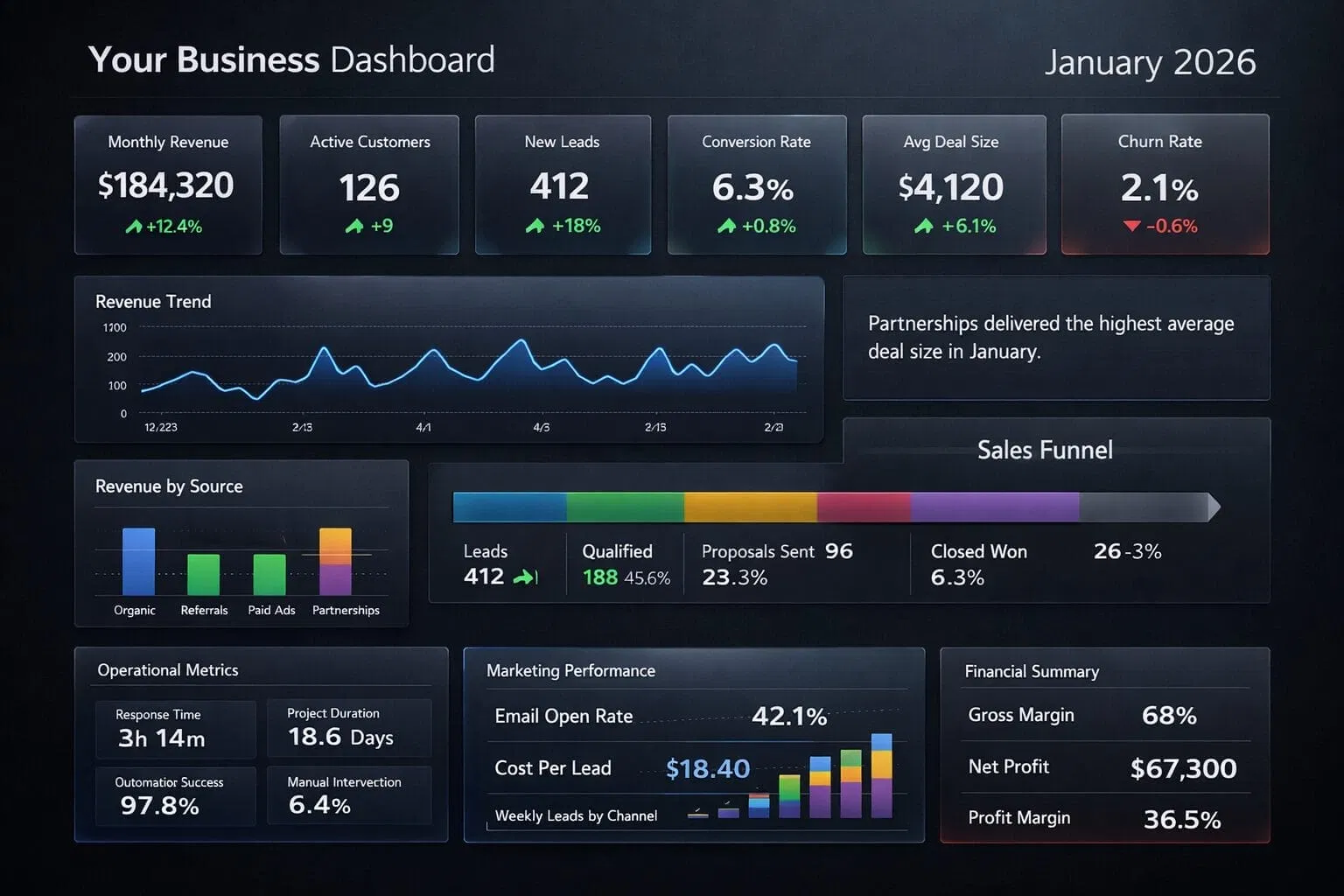
Use your dashboard to track:
- Success Rates: How many tasks were completed without human intervention?
- Error Rates: Where is the AI failing?
- ROI: Are you seeing the projected decrease in operational costs?
Once the first integration is stable and profitable, move to the next. Scale horizontally by applying similar logic to other departments. If your marketing automation worked, apply those learnings to your HR onboarding or your financial reporting.
Success leaves clues. Document your automation logic so it can be replicated as you hire more people and take on more clients.
Why Founders Choose Yotomations for AI Integration
Scaling a startup is hard enough without having to become a full-time automation engineer. Most founders recognize the need for business process automation but lack the time or technical depth to execute it flawlessly.
That is where we come in. At Yotomations, we don't just "install" software. We build the digital nervous system of your business. From n8n automation to complex custom software development, we ensure your tech stack is an asset, not a liability.
Ready to stop doing manual work and start scaling?
- Explore our full-scale expression of automation.
- See how we handle smooth handoffs between systems.
- Check out our category sitemap for more insights on AI-driven growth.
The future of your startup is autonomous. Let’s build it together.
Summary Checklist for Founders:
- Identify one process that takes more than 5 hours a week.
- Document every click and decision in that process.
- Choose an integration partner (like Yotomations) to build a PoC.
- Train your team to manage the output, not the task.
- Reclaim your time and focus on your next funding round or product launch.
Execution. That is the difference between a startup that survives and one that scales. Stop manual tasks today. Leverage ai integration services and turn your business into a high-output machine.
