5 Steps How to Deploy AI Automation and Reclaim 20 Hours a Week (Easy Guide for Small Business)
Time is the only currency you can’t earn back. For small business owners, the "hustle" often translates to 80-hour weeks spent on data entry, chasing invoices, and triaging emails. It’s exhausting. It’s inefficient. And frankly, in 2026, it’s unnecessary.
At Yotomations, led by our CEO Yaakov (Koby) Oranski, we see this daily: brilliant entrepreneurs buried under $15-an-hour tasks. The solution isn't hiring more people; it's business process automation. By deploying strategic AI automation, you aren't just "saving time." You are reclaiming your life and scaling your output without scaling your overhead.
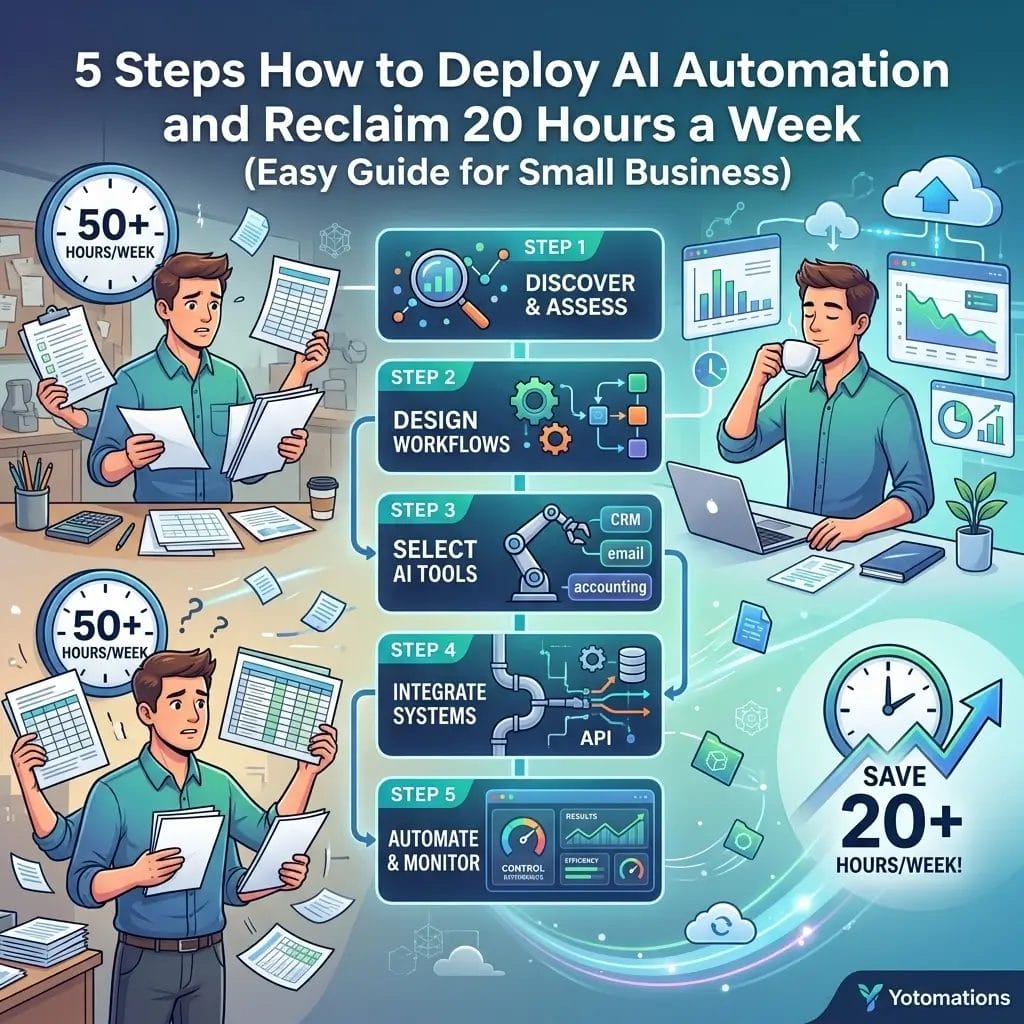
If you want to pull 20 hours of manual labor out of your work week, you need a system. Here is the exact 5-step framework we use to transform chaotic operations into autonomous machines.
Step 1: Map Your Automation Landscape (The Audit)
You cannot automate what you do not understand. Most owners jump straight to the "cool tools" and fail. Execution starts with clarity.
Start by documenting every repetitive task your team performs. We look for the "Rule of 50": any process that happens 50 or more times a week is a prime candidate for workflow automation. Focus on these high-friction areas:
- Customer Operations: Onboarding, ticket sorting, and FAQ responses.
- Financial Cycles: Invoicing, accounts receivable follow-ups, and expense categorization.
- Content Production: Social media scheduling, proposal drafting, and contract generation.
Stop automating chaos. If your manual process is broken, automating it only makes it fail faster. Map the "as-is" state before you build the "to-be" state.
Step 2: Define Success Metrics (The ROI)
"Saving time" is too vague. To justify the shift to AI integration services, you need hard numbers. Before we write a single line of code or build a single workflow in n8n automation, we establish a baseline.
What does your current "manual" state look like?
- Time per task: How many minutes does it take to onboard one client?
- Error rate: How often are typos made in your CRM?
- Labor cost: What is the hourly rate of the person currently doing this?
At Yotomations, we aim for a 20-25% reduction in total team hours within the first 30 days of deployment. If your team currently spends 100 hours a week on admin, our goal is to give you back 20 to 25 of those hours immediately. This isn't theory; it’s math.
Check out our guide on how to automate business processes without breaking the bank to see how these metrics translate to real-world savings.
Step 3: Select Your Tech Stack (No-Code vs. Custom)
This is where most small businesses get stuck. Do you buy off-the-shelf software, or do you invest in custom software development?
The answer depends on your complexity. For 80% of small businesses, a hybrid approach is best. We leverage powerful platforms like Airtable automation and Make to bridge the gaps between your existing tools.
- Airtable: Your central "brain" for data. (See our comparison: Airtable vs. Custom Software).
- Make / n8n: The "nervous system" that moves data between apps.
- AI Integration: Using LLMs (like GPT-4o) to handle cognitive tasks like summarizing emails or drafting responses.
Strategy: Don't buy 20 different tools. Marketing automation AI works best when it's unified. If you're tired of paying for a dozen subscriptions that don't talk to each other, read our breakdown on unifying your tech stack.

Step 4: Launch a 30-Day Pilot (The Sprint)
Do not try to automate your entire company at once. You will fail. Instead, pick one high-volume workflow: for example, your lead intake process: and run a pilot.
During this phase, we run "Parallel Operations." The AI handles the task, but a human does a quick 2-minute review. This ensures data integrity and builds trust in the system.
The Goal: Move a task from 30 minutes of human effort to 2 minutes of human oversight. That 28-minute delta, multiplied by 50 occurrences a week, is where you reclaim your first 23 hours.

If you find your automations are hitting a wall, it might be due to common pitfalls. We've documented 10 reasons why automation fails and how to bypass them.
Step 5: Measure, Refine, and Scale
Automation is not "set it and forget it." It is an iterative process. After 30 days, we look at the data.
- Did we hit the 20-hour reclamation goal?
- Where did the AI struggle?
- Is the team happier now that the "grunt work" is gone?
Once the first pilot is successful, we document the logic and move to the next department. This creates a culture of efficiency. At Yotomations, we help businesses transition from manual chaos to small business growth by systematically removing bottlenecks one by one.
For more real-world examples, browse our 20 use cases for custom software to see what's possible for your specific industry.
Why Yotomations?
We don't just sell software; we deliver freedom.
Small to medium business owners are the backbone of the economy, but they are often the most overworked. Yaakov (Koby) Oranski founded Yotomations on a simple principle: technology should serve people, not the other way around.
Whether you need a simple n8n automation to sync your CRM or a complex custom software development project to overhaul your entire operations, we have the expertise to make it happen.
Ready to get your 20 hours back?
Stop guessing and start automating. The gap between where you are and where you want to be is filled with manual tasks that an AI could do while you sleep.
- Explore our services: Business Automation
- Optimize your CRM: Workflow & CRM Systems
- Stay Updated: Yotomations News
The choice is yours: stay buried in the weeds, or build a machine that works for you.